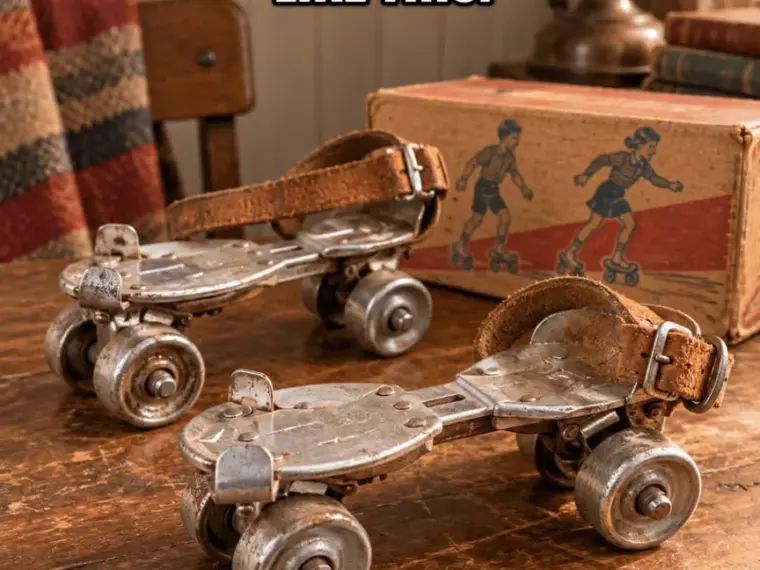
There was a time when roller skating didn’t involve sleek boots, colorful wheels, adjustable trucks, or high-tech bearings. If you wanted to roll, you had to strap a small metal contraption directly onto your ordinary shoes and hope for the best.
And honestly? Looking at these old-fashioned skates, it’s hard not to wonder how anyone stayed upright!
The vintage pair in the image is a wonderful reminder of just how much everyday technology has changed. Heavy metal frames, chunky wheels, leather straps, buckles and a little adjustment key made up what was once cutting-edge skating equipment.
The original idea was wonderfully simple
Instead of putting wheels underneath a purpose-built boot, early roller skates were designed to attach to the shoes you were already wearing.
The skate would sit beneath the sole while clamps or straps held it in place. Some designs could be adjusted to fit different shoe sizes, making them considerably more practical than having to own a dedicated pair of skating shoes.
The result was essentially a tiny wheeled platform attached to your feet.
Vehicle Wheels & Tires
That’s another question.
A little history on wheels
Experiments with wheeled footwear go back well before the modern roller skate. But the development of practical roller skates accelerated during the 19th century.
In 1863, American inventor James Leonard Plimpton patented a four-wheeled roller skate design that helped transform roller skating. His improvements made skating more controllable and contributed to the sport becoming increasingly popular. (Blogs du Congrès)
Roller skating eventually became a major recreational craze, particularly in the late 19th and early 20th centuries. The Library of Congress notes that roller skating was already becoming a widespread pastime, with another major revival occurring around 1905 as new rinks opened. (Bibliothèque du Congrès)
So those humble-looking wheels weren’t merely children’s toys. They were part of a much larger cultural phenomenon.
And then there was the famous clamp-on skate
One particularly recognizable style used metal clamps to grip the shoe.
TO CONTINUE READING THE ARTICLE PLEASE SEE PAGE 2