My Mom Secretly Cooked Three Meals a Day for a Homeless Man Behind Our House for 20 Years. The Day After Her Fun*ral, He Took My Hands and Said, “Before She D*ed, She Begged Me to Stay Silent.”
For twenty years, I resented a homeless man for eating food my family could barely afford to give.
I did not find out until the day after I said my last goodbye to my mother that I had spent two decades hating my own father.
PART 1
My name is Hannah, and for most of my life I believed my mother loved a stranger more than she loved being able to pay our bills.
For twenty years, a man named Vernon lived in a makeshift shelter behind our rental house.
And for twenty years, my mother, Ruth, made him three meals a day.
She did it when the heat got shut off. She did it when my sneakers had tape over the holes. She did it the winter the landlord posted a yellow eviction notice on our door two days before Christmas.
I hated it.
Not because Vernon was homeless. I want to be clear about that.
I hated it because we were poor too, and every plate she carried out back felt like food taken out of my own mouth.
“Maybe if you stopped feeding strangers,” I told her once, when I was fifteen and furious, “we wouldn’t have to live like this.”
My mother, who never raised her voice, exploded.
“Don’t you ever DARE say that to me again.”
I had never seen her like that. There was something behind it I did not understand, something fierce and frightening and bottomless.
So I stopped saying it. But I never stopped thinking it.
There were nights I lay awake doing the math a child should never have to do. Three plates a day, times three hundred and sixty-five days, times all the years I had been alive. An ocean of food, carried out the back door, while I wore the same winter coat two sizes too small for a second year.
I did not understand how a mother could look at her own cold, hungry daughter and still carry that tray out back without fail, rain or shine, fever or holiday.
I decided, somewhere in my teens, that she simply loved her charity more than she loved me.
It is the cruelest thing I ever believed, and I believed it for twenty years.
Years passed. I grew up. I moved out.
Mom and I fought less, mostly because I learned to stop asking about the man behind the house.
But Vernon was always there. A shape in the back lot. A shadow my mother carried a tray to, three times a day, in the rain, in the snow, for two decades.
Then, last spring, my mother got sick.
The cancer made her small, and quiet, and gray.
Two weeks before she was gone, she grabbed my wrist with a strength I did not know she still had, and she whispered, “Promise me, Hannah. Promise you’ll keep feeding Vernon.”
Every resentful thing in me wanted to say no.
But I could not lie to my mother in her final days.
So I promised.
And the day after her fun*ral, I cooked the best meal I knew how to make, and I drove to my mother’s house to keep a promise I did not understand.
But the shelter behind the house was empty. Cleared out. Gone.
Instead, a black SUV sat at the curb.
And beside it stood a clean-shaven man in an expensive coat, holding my mother’s old silver locket, the one she swore she had lost when I was eight years old.
“I thought you wouldn’t come,” he said, and his eyes filled.
“Vernon?” I could barely say it.
“Your mom hid something from you,” he said softly. “Before she d*ed, she begged me to stay silent.”
My bl*od went cold.
“What did she hide?” I whispered.
PART 2
Vernon’s hands were shaking as he held out the locket.
“Open it,” he said.
I did.
Inside was a photograph I had never seen. A young man, strong and laughing, with a toddler on his shoulders.
The toddler was me.
The man was him.
Younger. Clear-eyed. Whole. But unmistakably the man standing in front of me.
“I don’t understand,” I said, though some part of me, some deep and hidden part, was already beginning to.
“Hannah,” he said, and his voice broke on my name. “I’m your father.”
The plate of food slipped in my hands. I barely caught it.
“That’s not possible,” I said. “My father left. Mom said he left when I was little. She said he was gone.”
“He was gone,” Vernon said quietly. “Just not the way she let you believe.”
I looked down at the photograph again. At the laughing young man. At the little girl on his shoulders with her fists in his hair.
I knew that little girl. I had seen her in exactly two other photos my mother owned, photos where the man beside her had always, always been cut out of the frame.
I had asked about that once, as a child. Why Daddy was missing from the pictures. My mother had said the light had been bad.
The light had not been bad.
She had been protecting me from a face I was looking at right now.
And then, standing in the backyard where I had spent twenty years resenting him, my father told me the truth my mother had carried alone for two decades.
He had been a carpenter, once. A good one. He had built half the porches on our street.
When I was six years old, he fell from a scaffold on a job site, three stories, onto concrete.
He survived. But the man who woke up in that hospital was not entirely the man who had fallen.← Previous Page
The injury to his head took pieces of him. His memory. His balance. His ability to hold a thought, to keep a job, to trust his own mind from one hour to the next.
“I would forget where I was,” he said. “I would forget your names, for minutes at a time, and then it would come back, and the forgetting was so frightening that I started to believe you’d both be safer away from me.”
He had tried to stay. For a while, he had tried.
But a man who wanders off and cannot find his way home, who flies into confusion he cannot control, is not a safe thing to build a childhood around.
“One night I left,” he said. “I thought I was protecting you. I thought the kindest thing I could do was disappear.”
He told me about the last clear memory he had from before the fog took him for good. Me, at five, falling asleep on his chest while he read me the same book for the hundredth time.
“I held onto that one,” he said. “Through everything. On the worst nights, when I couldn’t remember my own name, I could still remember the weight of you asleep on me. That’s the thing that kept me from letting go entirely.”
I had to turn away from him then, because I could not breathe.
For twenty years I had thought my father was a man who had not wanted me.
He was a man who had loved me so much that he had tried to erase himself from my life rather than let me watch him break.
PART 3
But my mother would not let him disappear.
That was the part I had never known, the part that rearranged twenty years of my life in a single afternoon.
Ruth found him, weeks later, sleeping under an overpass two miles from our house, confused and half-starved and ashamed.
She had looked for him every day he was gone. She had driven every street, called every shelter, described his face to every officer who would listen.← Previous Page
And when she finally found him, he did not know her for the first few minutes. He looked at his own wife like she was a kind stranger.
She told him, later, that those were the worst minutes of her life, worse than the hospital, worse than anything. Watching the man she loved look straight through her.
She could not bring him back inside. In his condition, with a small daughter to raise, she knew she couldn’t. It would not have been safe for any of us, and the doctors had told her as much.
But she could not leave the man she loved to vanish into the streets either.
So my mother made an impossible choice, and then she kept it, every single day, for twenty years.
She let him live in the shelter behind the house, where she could see him from the kitchen window every hour of every day.
She fed him three meals a day, so the man she married would never, ever go hungry while she had a stove.
She watched over him. She made sure he had blankets in the winter and shade in the summer. She kept his medications sorted when he could not. On his bad nights, she sat out there with him in the dark until the confusion passed.
She kept him alive, and close, and cared for, in the only way their broken situation would allow. For twenty years. Without a single word of thanks from the daughter who watched her do it and called it foolishness.
And she told me he was a homeless man, because the truth, that my strong, laughing father had become a confused stranger in our own backyard, was more than she could bear to put on a child.
“I begged her to let you believe I was gone,” Vernon said, weeping openly now. “I didn’t want you to remember me like that. Scared. Broken. I wanted you to have a daddy in your memory who was whole. So I made her promise. And she made me promise to stay silent. For your sake. We both thought we were protecting you.”
I thought about every plate of food I had resented.
I thought about “maybe if you stopped feeding strangers.”
I thought about my mother’s face when she exploded at me, that bottomless, frightening thing behind her eyes, and I understood, finally, that it had not been anger.
It had been a grief so enormous she could not let a single crack of it show, or the whole thing would have swallowed her.
She had not been feeding a stranger.
She had been keeping my father alive, in front of me, for twenty years, and loving me too much to let me know it.
Every cruel thing I had ever thought about my mother turned over inside me and showed me its other face.
The eviction notice at Christmas. She had still carried out three plates, because stopping meant he would not eat.
The winters our heat was cut. She had made sure he had blankets, because he had no walls at all.
I had seen a woman giving our survival away to a stranger.
I had been watching the single most loyal act of love I will ever witness, and I had hated her for it.
PART 4
“Why now?” I finally managed. “Why tell me now?”
Vernon reached into his coat and took out an envelope, soft and worn from handling.
“Because she finally let me,” he said. “Right at the end.”
It was a letter, in my mother’s handwriting, and he pressed it into my hands the way she used to press a tray into his.
I will not share all of it. Some of it belongs only to me.
But she wrote that the accident had taken the husband she married, and that she had spent twenty years refusing to let it take him entirely, too.
She wrote that two years ago, a new doctor and a new treatment had finally started to bring Vernon back, his memory steadying, his mind clearing, the fog lifting after two decades.
She had driven him to every appointment herself, she wrote, parking two streets over so I would not see her car and ask questions. She had sat in waiting rooms for hours. She had learned the name of every medication, every therapy, every small exercise that might call another piece of him back from the dark.
She had been rebuilding my father, one quiet appointment at a time, while I thought she was just an aging woman growing stranger and more stubborn with her charity.
She wrote that she had spent those same two years quietly fighting the old insurance company, and that the settlement for his accident, stalled and denied for twenty years, had finally, finally come through, enough that he would never want for anything again.
She wrote that she had been waiting until he was well enough, and provided for enough, to be your father again, Hannah. And that she had run out of time before she could tell you herself.There was one more thing in the letter that undid me completely.
She wrote that every single meal she ever carried out that back door, for twenty years, she had made exactly the way Vernon liked it when they were young and in love and whole. His coffee strong. His eggs soft. A little too much salt, the way he always teased her for.
Twenty years of love letters, written in food, that I had counted as theft.
“Forgive me for the silence,” she wrote at the end. “I was never feeding a stranger. I was keeping your father until he could come home to you. Now he can. Let him.”
I sat down right there on the grass, holding my mother’s words, and I wept for the woman I had misjudged for twenty years, and for the father I had hated without knowing his name.
“I wanted to tell you a thousand times,” Vernon said. “Every time you looked at me with those angry eyes through the kitchen window, I wanted to run to you and say, it’s me, it’s your daddy. But I’d promised her. And she was right. You needed a childhood more than you needed a broken man.” He wiped his face. “She gave you one. She gave us both everything she had.”
Vernon lowered himself down beside me, slowly, carefully, and after a long moment, he reached out and took my hand.
It was the first time my father had held my hand since I was six years old.
His hands were a carpenter’s hands, rough and strong, exactly as I had forgotten they were.
“I’m here now, Hannah,” he said. “I’m not going anywhere. The getting-lost is over. I know exactly where home is.”
PART 5 — FINAL
We set down the resentment that afternoon, in that backyard, and we started, carefully, to build something in its place.
It was not instant. Twenty years do not dissolve in a single conversation.
There were hard days, days his memory still slipped, days I grieved all over again for the childhood the scaffold had stolen from both of us.
But my father was here. Well, and clear, and mine. And we had time now, the one thing my mother had run out of.
He moved into a small, bright house, the first walls that had been truly his in twenty years, and he filled it with the smell of sawdust again, building furniture slowly, steadily, the way his mind now worked.
The first thing he built was a long wooden table.
And that is where the rest of our story begins.
Because I kept my promise. I kept feeding people.
Only now it was not one man behind a house.
My father and I took the money my mother fought twenty years to secure, and we opened a community kitchen in the lot where his shelter used to stand.
We called it Ruth’s Table.
Three meals a day, for anyone who is hungry, for anyone the world has decided to stop seeing. No questions. No conditions. Exactly the way she did it.
We opened on the anniversary of the day she passed. Forty people came the first week. Now it is closer to three hundred a day.
My father greets every single person by name. He, of all people, knows what it means to be looked at and truly seen when you have nothing, to be handed a warm plate by someone who does not flinch from you.
Some of the people who come have been where he was. Living in the gaps of the world, invisible. He sits with them. He tells them, quietly, that he spent twenty years in a shelter behind a house, and that a good woman never once let him believe he was worth less than anyone else. He tells them it can turn around. Coming from him, they believe it.
The volunteers love him. The regulars call him Mr. Vernon. Children who come in with their parents climb on his shoulders the way I once did, and he lets them, every time, and I have to look away so they do not see me cry.
On the wall, we hung the photograph from the locket. The strong young man with a laughing toddler on his shoulders.
Underneath it, a small brass plate reads: She fed one man for twenty years, and called it love. We are just carrying the tray.
For twenty years, I thought my mother was giving our food away to a stranger.
She was keeping my father alive until the day he could stand in front of me as himself again.
She begged him to stay silent so I would not be hurt.
And she spent her whole life making sure that when the silence finally broke, there would be a father waiting on the other side of it.
There was.
His name is Vernon, and he is mine, and we set out three hundred plates a day now, in memory of the woman who taught us both exactly what a meal can mean.
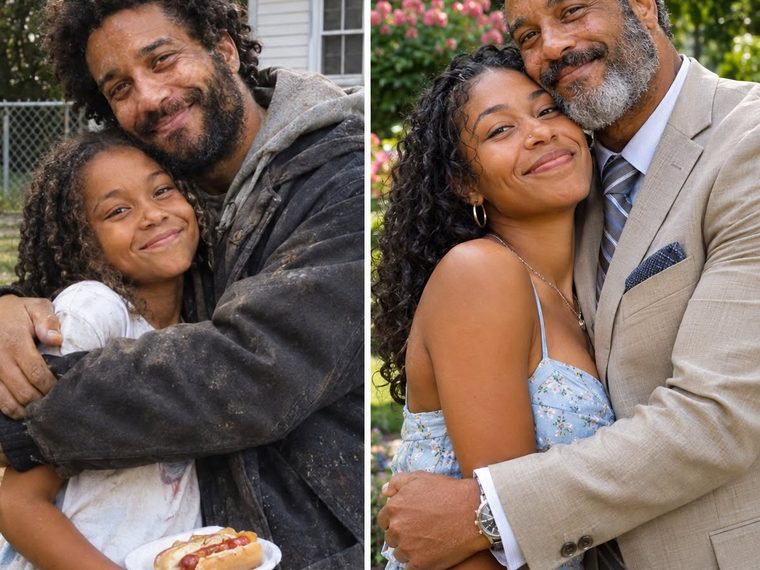
The photograph on the two sides of time is the one I keep by the door. A ragged man and a small girl in a backyard, and the same two people, twenty years later, whole and well and holding on.
I spent half my life ashamed of that backyard.
Now I know it was the most sacred ground I will ever stand on.
May you like