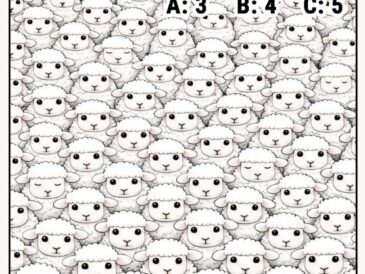
Have you ever been told you’re different? Here’s your chance to prove it. A new challenge is circulating on social media, and it seems surprisingly simple. Yet, almost no one succeeds on the first try. Or even on the second, for that matter. The most determined keep trying, convinced they’ve found the shortcut. Spoiler alert: it’s not as easy as it seems.
Why are we so addicted to these viral challenges?
We all know that feeling. You’re calmly scrolling through social media and suddenly a video or question catches your attention. You think, “Hold on, I’ll give it a look.” Twenty minutes later, you’re still there, determined not to give up.
It’s no coincidence. These challenges are based on a well-known mechanism: the need to prove something to ourselves. Our brains love short challenges with an immediate reward, even a symbolic one. Success is satisfying. Failure is motivating. In both cases, we stay engaged. Brilliant, right?
The famous “99% flaw”: what is it really?
The Spanish expression “99% falla” simply means: 99% of people fail. It’s the perfect example of how the challenges of perception, logic, and attention that are flooding news feeds right now are constant.
The principle is always the same: a question, an image, or an instruction that seems obvious… but with a well-hidden trap. The error creeps in where you least expect it. In a word you read too quickly. In a visual detail you miss. In a logic you think you’ve figured out.
And that’s exactly why everyone succumbs to pressure. We move too fast. We trust our first instincts. And our brain, that little trickster, plays tricks on us
How to get into the far end of the famous 1%?
Good news: It’s not a question of intelligence. It’s a question of method. People who succeed in this type of challenge have simply learned to slow down.
Some simple habits that make a difference:
– Read twice before answering. Most mistakes come from reading too quickly. – Look for unexpected details. If something seems too simple, there’s definitely a catch. – Trust your instincts… but check them. Our first impressions are often influenced by what we expect to see. – Take a moment to breathe. A different perspective on a puzzle often makes all the difference.
These small habits can be applied well beyond viral challenges. In everyday life, at work, when reading a contract or an ambiguous message, slowing down is often a winning strategy.
A fun workout for the mind
The beauty of these challenges is that they’re much more useful than they seem. They train attention, concentration, and critical thinking: valuable skills presented in a fun and accessible format.
So, the next time you face an “impossible” challenge on your screen, smile. Now you know how to tackle it.
The secret of the 1%? They’re never in a hurry.