Did the Store Scam Me? Why Your Ground Beef Is Red Outside but Gray Inside
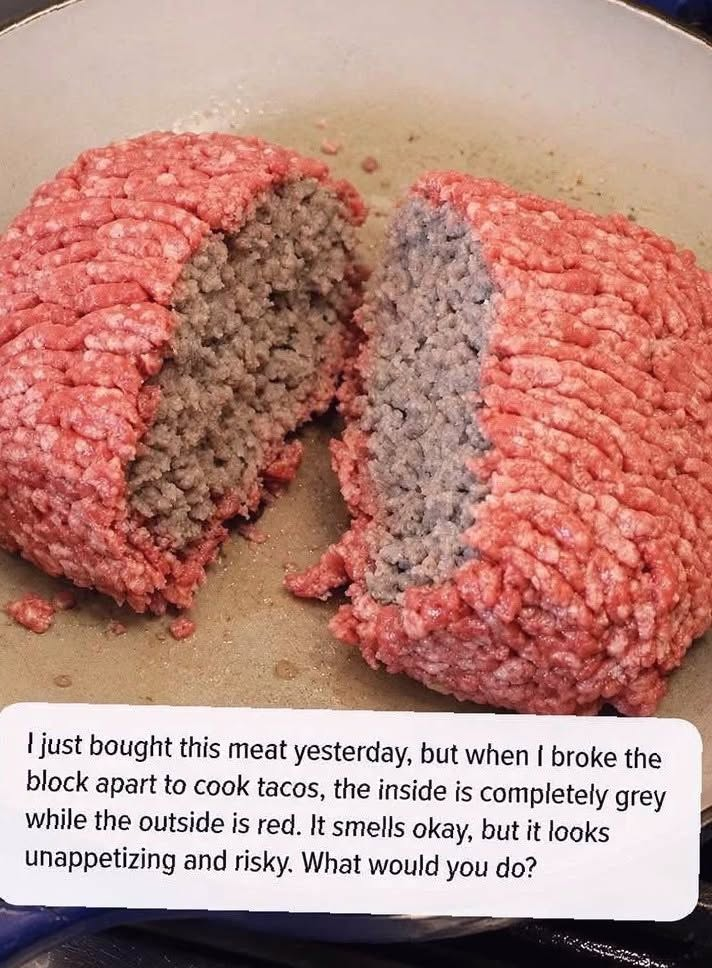
You bring home a package of ground beef from the grocery store.
From the outside, it looks perfect.
Bright red.
Fresh-looking.
Exactly what you’d expect from a package of beef sitting in the refrigerated meat section.
But then you open it.
And suddenly, something looks completely different.
The center is grayish-brown.
You stare at it.
Then you look back at the package.
And one question immediately comes to mind:
“Did the store just sell me old meat?”
It’s an understandable reaction.
Bright red meat is strongly associated with freshness, so discovering a darker center can make you wonder whether the package has been sitting around too long—or whether the store is trying to make the meat look fresher than it really is.
But here’s the surprising part:
Red on the outside and grayish-brown on the inside can be completely normal.
The explanation has to do with something much simpler than a grocery-store scam.
It has to do with oxygen.
Why Is the Outside Bright Red?
The color of fresh beef is largely influenced by a protein called myoglobin.
Myoglobin is found naturally in muscle tissue and plays an important role in how meat gets its characteristic color.
When the surface of ground beef is exposed to oxygen, myoglobin interacts with that oxygen and forms oxymyoglobin, which produces the familiar bright red color shoppers associate with fresh beef.
That’s why the outside of a package can look so red and appealing.
The meat is exposed to the air.
The oxygen reaches the surface.
And the chemical reaction changes its appearance.
But the center of the package is a different story.
Why Is the Inside Gray?
Oxygen doesn’t penetrate the entire package of ground beef equally.
The meat on the outside is exposed to air, while the meat packed tightly in the center has much less contact with oxygen.
As a result, the interior can remain grayish-brown or purplish even while the exterior is bright red.
According to the USDA, this difference in color can occur because of varying levels of oxygen exposure within the package.
So when you open the package and discover a darker center, it doesn’t automatically mean you’ve been sold spoiled meat.
In fact, it may simply mean that the center hasn’t been exposed to as much oxygen as the surface.
So… Is the Store Scamming You?
Usually, no.
The red exterior isn’t necessarily an artificial attempt to disguise spoiled beef.
It’s a natural chemical reaction.
The same basic principle explains why fresh beef can look different depending on whether it has been exposed to air.
Think of it this way:
Outside + oxygen = brighter red
Inside + limited oxygen = darker color
That doesn’t mean every gray piece of ground beef is safe, however.
And that’s where things get important.
Color Alone Cannot Tell You If Beef Is Safe
One of the biggest mistakes consumers make is judging meat entirely by its color.
A change in color by itself does not necessarily mean spoilage.
But the opposite is also true:
Normal-looking color does not guarantee that ground beef is safe.
Harmful bacteria cannot reliably be detected by looking at the meat, smelling it, or examining its color.
That’s why proper storage and cooking are so important.
If the beef has been handled improperly or stored too long, it can pose a food-safety risk even if it still looks reasonably normal.
What Are the Warning Signs?
Instead of focusing only on color, pay attention to the overall condition of the meat.
Signs of spoilage can include:
- An unpleasant or abnormal odor
- A sticky or slimy surface
- Damaged or leaking packaging
- Meat that has been stored improperly
- Beef that has remained refrigerated beyond the recommended storage period
USDA guidance notes that spoilage bacteria can cause meat to develop an unpleasant odor and a sticky or slimy texture.
If your ground beef has several warning signs, don’t take chances.
When in doubt, throw it out.
How Long Can Ground Beef Stay in the Refrigerator?
This is one detail that matters far more than whether the meat is bright red.
USDA guidance recommends keeping raw ground beef refrigerated at 40°F (4.4°C) or below and using it within 1 to 2 days, or freezing it for longer storage.
That means if you purchased ground beef several days ago and it has been sitting in the refrigerator, you shouldn’t assume that a normal-looking color means it’s still safe.
Storage time matters.
Temperature matters.
Handling matters.
Color is only one small part of the picture.
What If the Entire Package Has Turned Gray?
This is different from seeing a gray center.
If only the interior is darker while the outside remains red, oxygen exposure may explain the difference.
But if the entire package has become gray or brown, especially alongside an unpleasant smell or slimy texture, that’s a different situation.
USDA notes that when all the meat in a package has turned gray or brown, it may be beginning to spoil.
In that situation, don’t assume that cooking will automatically make questionable meat safe.
Don’t Trust the Color of Cooked Beef Either
There’s another surprising fact about ground beef:
You can’t reliably judge whether it’s safely cooked just by looking at its color.
A burger can remain pink even after reaching a safe temperature.
Another burger can look brown before it has reached the temperature needed to destroy harmful bacteria.
That’s why USDA recommends using a food thermometer rather than relying on appearance.
For ground beef, the recommended safe minimum internal temperature is 160°F (71°C).
So if you’re cooking burgers, meatballs, tacos, meatloaf, or another ground-beef dish, a thermometer is much more reliable than simply cutting the meat open and looking at it.
Why Ground Beef Requires Extra Attention
Ground beef is different from an intact steak.
When a steak is ground, bacteria that may have been present on the surface can become distributed throughout the meat.
Grinding also increases the amount of surface area exposed to the environment.
That’s one reason USDA recommends cooking ground beef thoroughly and handling it carefully.
It also explains why proper refrigeration is so important.
Keep it cold.
Use it promptly.
And cook it thoroughly.
How to Choose Ground Beef at the Store
There are a few simple habits that can make grocery shopping safer.
Look for packages that are:
Cold.
The meat should be properly refrigerated.
Intact.
Avoid packages that are torn, leaking, or badly damaged.
Within the appropriate date guidance.
Don’t ignore dates and storage instructions.
Free from obvious spoilage signs.
An unusual smell or visibly slimy texture is a reason to avoid the product.
USDA also recommends making ground beef one of the last items you place in your cart and taking it home promptly so it stays cold.
What Should You Do When You Get Home?
Don’t leave your ground beef sitting on the kitchen counter while you finish putting everything else away.
Get it into the refrigerator or freezer as soon as practical.
If you plan to use it within the recommended refrigerator storage period, keep it refrigerated at 40°F (4.4°C) or below.
If you won’t use it soon, freezing is a better option.
And when you’re preparing it, keep raw meat separate from foods that won’t be cooked.
Wash your hands and clean surfaces and utensils after handling raw ground beef.
These simple habits can significantly reduce the risk of cross-contamination.
So What Did You Actually See?
If you opened your package and saw something like this:
Bright red outside.
Grayish-brown inside.
Don’t immediately assume you’ve been scammed.
There is a perfectly ordinary scientific explanation.
The outside has been exposed to oxygen.
The inside has had much less oxygen.
That difference can change the color of the meat without automatically meaning that it’s spoiled.
But don’t let that explanation make you careless, either.
If the meat smells bad, feels slimy, has been stored improperly, or has been refrigerated longer than recommended, color shouldn’t reassure you.
The Bottom Line
So, did the store scam you?
Probably not—at least not simply because the ground beef was red on the outside and grayish-brown in the center.
That appearance can be a normal result of oxygen interacting differently with the meat.
But there’s an important lesson here:
Don’t use color alone to decide whether ground beef is safe.
Pay attention to storage time, temperature, smell, texture, packaging, and proper cooking.
Keep raw ground beef refrigerated at 40°F (4.4°C) or below and use or freeze it within 1–2 days. When cooking, use a food thermometer and bring the meat to 160°F (71°C).
So the next time you open a package and discover a gray center, don’t panic.
It may not be a scam.
It may simply be science happening inside your hamburger.