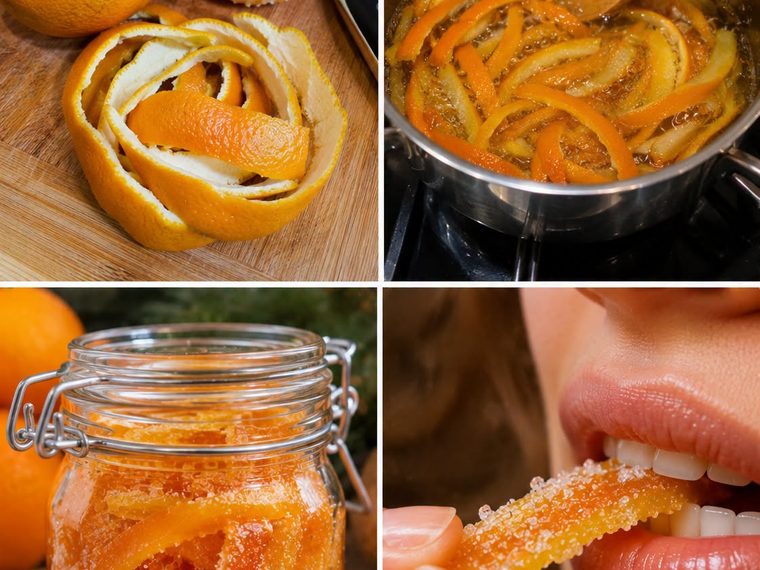
Every winter, millions of orange peels end up in the trash. But what if those fragrant scraps could become one of the prettiest homemade treats on your Christmas table?
With just orange peels, sugar, and water, you can make candied orange peels, a traditional sweet with a soft, chewy center, a slightly firm exterior, and a delicious citrus flavor.
They’re wonderful dipped in dark chocolate, sprinkled with sugar, added to holiday cakes, or packaged in little jars as homemade Christmas gifts.
And the best part? You don’t need any special equipment.
The secret is to remove some of the peel’s natural bitterness before slowly simmering it in sugar syrup.
Here’s how to turn something you’d normally throw away into a beautiful homemade holiday candy.
Why Orange Peels Make Such Delicious Candy
Orange peels contain aromatic oils responsible for their unmistakable citrus fragrance.
The outer orange layer, called the flavedo, contains most of these fragrant oils. Beneath it is the white pith, known as the albedo.
The pith contributes bitterness, but it also gives candied orange peels their characteristic chewy texture.
When the peels are briefly boiled in fresh water and then simmered in sugar syrup, their flavor becomes milder and sweeter.
As the syrup penetrates the peel, it transforms the texture from tough and bitter into tender and pleasantly chewy.
This is why candied orange peel has been a popular ingredient in European Christmas baking for generations.
What You’ll Need
<text color=”secondary” size=”sm”>Prep time: 15 minutes | Blanching: 15–25 minutes | Simmering: 45–60 minutes | Drying: 4–12 hours | Yield: Approximately 1–2 cups, depending on peel thickness</text>
Ingredients
- Peels from 4 large oranges
- 2 cups (400 g) granulated sugar
- 2 cups (480 ml) water, for the syrup
- Additional water for blanching
- ½ cup (100 g) granulated sugar, optional, for coating
- 100–150 g dark chocolate, optional, for dipping
Equipment
- Sharp knife
- Cutting board
- Medium saucepan
- Colander
- Tongs or slotted spoon
- Wire cooling rack
- Baking sheet
- Parchment paper
- Clean, airtight container
Tip: Choose fresh, firm oranges with thick, fragrant peels. If possible, use unwaxed oranges sold as suitable for using the zest or peel.
Step 1: Wash and Peel the Oranges
Start by washing the oranges thoroughly under running water, gently rubbing the surface to remove dirt.
Dry them with a clean kitchen towel.
Cut off the top and bottom of each orange. Score the peel into four or six sections, cutting through the skin but not deeply into the flesh.
Carefully remove the peel in large pieces.
Don’t worry about leaving some white pith attached. It helps create the chewy texture that makes candied orange peel so delicious.
However, if the pith is exceptionally thick, you can trim a little away.
Cut the Peels Into Strips
Place the peel pieces on a cutting board and slice them into strips approximately ¼ inch (6 mm) wide.
Try to keep the strips similar in size so they cook evenly.
You can also cut them into small cubes if you plan to use them in Christmas cakes, cookies, or panettone.
Step 2: Boil the Peels to Reduce Bitterness
This is one of the most important steps.
Fresh orange peels can be quite bitter, especially when they contain a thick layer of white pith.
Blanching helps remove some of that bitterness.
- Place the orange peel strips in a saucepan.
- Cover them with fresh cold water.
- Bring the water to a boil.
- Simmer for approximately 5 minutes.
- Drain the water completely.
- Repeat the process two more times with fresh water.
For most sweet oranges, three rounds of blanching produce a pleasantly mild result.
If you’re using especially bitter peels, you can blanch them once more.
Helpful tip: Don’t skip this step. Simmering untreated peels directly in sugar syrup can leave the finished candy unpleasantly bitter.
Step 3: Prepare the Sugar Syrup
After blanching the peels, rinse the saucepan.
Add:
- 2 cups granulated sugar
- 2 cups water
Heat over medium heat, stirring gently until the sugar dissolves.
Once the syrup is clear, add the blanched orange peel strips.
Reduce the heat to low.
The peels should remain mostly submerged in the syrup.
Step 4: Simmer Until the Peels Become Translucent
Allow the orange peels to simmer gently for approximately 45–60 minutes.
Avoid a vigorous boil, which can cause the syrup to evaporate too quickly or the peels to become tough.
Stir occasionally and carefully.
As the peels cook, you’ll notice several changes.
Their color becomes deeper and glossier, the white pith gradually looks more translucent, and the syrup begins to thicken.
The strips should become tender and flexible.
How Do You Know They’re Ready?
Lift one strip with a spoon and allow it to cool slightly.
It should look glossy, feel tender, and bend without breaking.
The white pith should no longer look completely opaque.
If the peels are still tough, continue simmering for another 10–15 minutes.
Important: Don’t cook the syrup until it turns dark brown or caramelizes. The goal is tender, syrup-infused orange peel, not burnt sugar.
Step 5: Let the Candied Peels Dry
Once the peels are tender, remove them from the syrup using tongs or a slotted spoon.
Arrange them in a single layer on a wire rack positioned over a baking sheet.
Leave space between the strips so they don’t stick together.
Allow them to dry at room temperature for approximately 4–12 hours, depending on humidity and thickness.
They should become tacky rather than wet, with a slightly firm surface and a soft, chewy interior.
In humid conditions, drying may take longer. Protect the peels from insects and dust.
Can You Dry Them in the Oven?
Yes.
If your oven supports a very low temperature, around 140–150°F (60–65°C), you can use it to help dry the peels.
Arrange them on a lined baking sheet and check frequently.
Avoid high heat, which can make the sugar coating sticky, hard, or scorched.
A food dehydrator at a low setting is another option.
Step 6: Coat the Peels With Sugar
For the classic sparkling appearance, roll the partially dried orange strips in granulated sugar.
The surface should be slightly tacky so the sugar sticks.
Place the coated strips back on the rack and allow them to dry further until the coating feels relatively dry.
The result is a beautiful homemade candy with a bright orange center and a delicate sugar-crystal coating.
These look especially attractive in small glass jars or holiday gift boxes.
Step 7: Make Chocolate-Dipped Candied Orange Peels
If you want to make them even more special for Christmas, try dipping them in dark chocolate.
The combination of citrus and chocolate is a holiday classic.
How to Make Them
- Make sure the candied orange strips are dry on the surface.
- Melt 100–150 g of dark chocolate gently in a microwave or over a water bath.
- Dip one end of each orange strip into the melted chocolate.
- Allow the excess chocolate to drip off.
- Place the strips on parchment paper.
- Let the chocolate set completely.
For the neatest finish, use strips that haven’t been rolled in sugar, although sugar-coated strips can also be dipped.
Tip: Dark chocolate with approximately 60–70% cocoa solids balances the sweetness of the orange peel particularly well.
Five Delicious Ways to Use Candied Orange Peels
You don’t have to eat them only as candy. They’re surprisingly versatile in holiday baking.
1. Homemade Christmas Gifts
Fill small glass jars with sugar-coated candied orange peels.
Add a ribbon and a handwritten label.
They’re attractive, inexpensive, and thoughtful homemade gifts.
2. Chocolate-Dipped Holiday Treats
Dip the strips halfway into dark chocolate and arrange them on a festive serving plate.
The orange-and-chocolate combination looks beautiful and tastes even better.
3. Christmas Cakes and Panettone
Chop the candied peels into small cubes and add them to fruitcakes, sweet breads, muffins, or homemade panettone.
They provide bursts of citrus flavor.
4. Cookies and Biscotti
Add finely chopped candied orange peel to shortbread, biscotti, or chocolate cookies.
A little goes a long way.
5. Cake and Dessert Decorations
Use thin candied orange strips to decorate cheesecakes, chocolate cakes, cupcakes, and other desserts.
They add both color and flavor.
Don’t Throw Away the Leftover Orange Syrup Either
After cooking the peels, you’ll have a fragrant orange-flavored sugar syrup.
Instead of discarding it, you can use it in several ways.
Try adding a small amount to:
- Hot tea
- Pancakes or waffles
- Homemade lemonade
- Cake glazes
- Yogurt or desserts
Strain the syrup into a clean container and refrigerate promptly.
Use it within approximately 1–2 weeks, or freeze it for longer storage.
Important: This homemade syrup is not a tested shelf-stable preserve. Don’t store it at room temperature.
How to Store Homemade Candied Orange Peels
Proper storage is especially important because homemade candied peels may retain more moisture than commercially manufactured versions.
Refrigerator Storage
Place fully cooled candied peels in a clean, airtight container.
Separate layers with parchment paper to prevent sticking.
Refrigerate at 40°F (4°C) or below and use within approximately 2 weeks for best quality.
Freezer Storage
For longer storage, freeze the candied peels in a freezer-safe container.
Separate the layers with parchment paper.
For best flavor and texture, use within approximately 3 months.
Thaw in the refrigerator.
What About Room-Temperature Storage?
Commercial candied peels may be shelf-stable because their sugar concentration and moisture content are carefully controlled.
Homemade versions are less predictable.
Unless you’re following a validated preservation process, don’t assume homemade candied orange peels are safe for extended room-temperature storage.
For homemade gifts, let recipients know that the candy should be refrigerated.
Discard any batch showing mold, fermentation, or an unusual odor.
Common Mistakes to Avoid
Skipping the Blanching
The peels may retain too much bitterness.
Blanch them in fresh water before adding them to the syrup.
Cutting Uneven Strips
Thin strips may become overcooked while thick ones remain tough.
Keep the pieces reasonably uniform.
Boiling the Syrup Too Hard
Rapid boiling can cause excessive evaporation and scorching.
A gentle simmer works best.
Not Drying the Peels Enough
Wet, sticky peels are harder to coat with sugar and may spoil more quickly.
Allow adequate drying time.
Using Oranges With Unsuitable Peel Treatments
Some citrus fruits are treated after harvest with waxes or fungicides.
Washing helps remove dirt and some surface residues, but it doesn’t reliably remove every postharvest treatment.
Choose oranges whose labeling or supplier indicates that the peel is suitable for culinary use.
Frequently Asked Questions
Can you really make candy from orange peels?
Yes. Orange peels can be blanched, simmered in sugar syrup, and dried to create a traditional chewy citrus candy.
Do you need to remove all the white pith?
No. Some white pith helps give candied orange peels their characteristic texture. Blanching reduces much of the bitterness.
Can I use mandarin or tangerine peels?
Yes, although their thinner peels may cook faster and produce a different texture. Adjust the simmering time accordingly.
Can I make candied orange peels without sugar?
Traditional candied orange peels depend on sugar for their sweetness, texture, and preservation characteristics. Sugar-free versions require a different recipe and won’t behave the same way.
Why are my candied orange peels still sticky?
They may need additional drying time. Humidity can also affect how quickly the surface dries.
Can I use the leftover syrup?
Yes. Refrigerate it and use it in drinks, glazes, or desserts.
Are candied orange peels healthy?
Orange peel contains plant compounds and some fiber, but candied orange peel also contains substantial added sugar. Enjoy it as an occasional sweet treat rather than a health supplement.
Can I make these ahead of Christmas?
Absolutely. Prepare them in advance and store them in the refrigerator or freezer, following the storage guidance above.
Final Thoughts
The next time you peel an orange, don’t be so quick to throw the skin away.
With a little sugar, water, and patience, those fragrant peels can become beautiful homemade candy that’s perfect for the holiday season.
The process is wonderfully simple: wash, peel, slice, blanch, simmer in syrup, and dry.
Roll the finished strips in sugar for a classic sparkling treat, or dip them in dark chocolate for something extra special.
They’re delicious on their own, beautiful in Christmas gift jars, and incredibly useful in holiday baking.
Sometimes, the best homemade treats begin with ingredients we almost threw away.
And these golden, sugar-coated orange peels are a delicious reminder that even kitchen scraps can become something special.