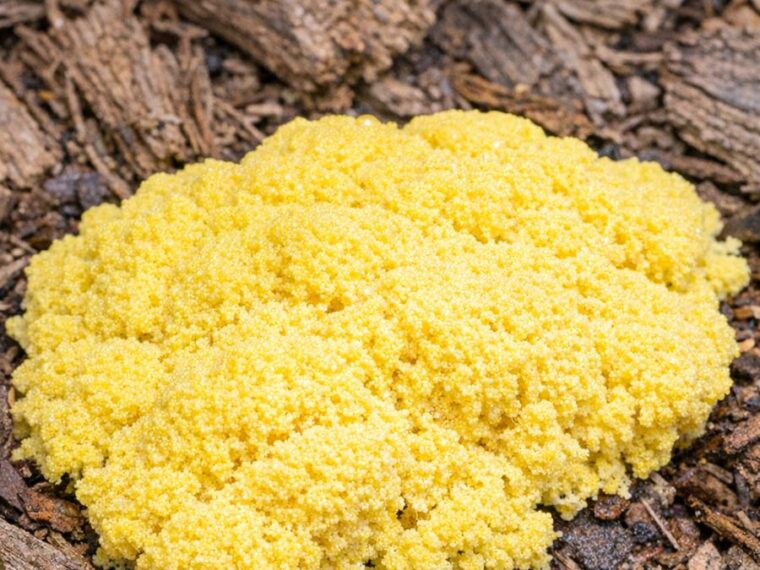
Imagine waking up one morning to find a peculiar, bright yellow, frothy patch on your mulch, resembling something like expanding foam. This unusual sight can be quite alarming, especially if it’s your first encounter with such a phenomenon. But don’t worry—what you’ve most likely stumbled upon is a fascinating organism known as dog vomit slime mold.
Dog vomit slime mold, scientifically known as Fuligo septica, is a type of slime mold that frequently appears in gardens and on mulch. While its sudden appearance may seem mysterious, it plays a unique role in the ecosystem. This article will delve into the details of what this bright yellow patch is, why it appears overnight, and what you can do about it.
1. What That Bright Yellow, Frothy Patch on Your Mulch Really Is
The bright yellow, frothy patch you discovered on your mulch is a type of slime mold called dog vomit slime mold. It belongs to the Myxomycetes class and is often found on mulch, decaying wood, and other organic materials. This organism is not a fungus but is classified as a protist. It can grow up to 2 square feet in size and typically appears as a bright yellow mass that eventually turns brown.
Dog vomit slime mold is saprophytic, meaning it feeds on dead organic material. It plays an important role in breaking down this material, helping to recycle nutrients back into the soil. Although its appearance might be off-putting, it’s a harmless and natural part of the decomposition process.
2. Why Dog Vomit Slime Mold Suddenly Appears Overnight
The overnight appearance of dog vomit slime mold is due to its rapid growth cycle and favorable environmental conditions. Slime molds thrive in warm, moist environments, which are commonly found in gardens with mulch during spring and summer. When the conditions are right—typically after a rain shower followed by warm temperatures—the spores can germinate quickly.
Once the spores germinate, they form a plasmodium, which is a mass of protoplasm that moves like an amoeba. This stage can happen very rapidly, leading to the seemingly overnight appearance of the slime mold. The organism moves over the mulch surface, engulfing bacteria, spores, and other organic matter, which contributes to its rapid growth.
3. How to Tell Dog Vomit Slime Mold From Expanding Foam or Fungus
While dog vomit slime mold can resemble expanding foam, several key characteristics distinguish it. Unlike expanding foam, which is solid and uniform in texture, slime mold has a spongy, frothy appearance and can vary in color as it matures—from bright yellow to brown. Slime mold also has a distinct, somewhat unpleasant odor.
In contrast to fungi, slime molds do not have a structured fruiting body like mushrooms. Instead, they spread as a plasmodium across the surface. If you gently touch it, you’ll find that it’s soft and easily disturbed, unlike the firm structure of expanding foam or fungal fruiting bodies.
4. Is Dog Vomit Slime Mold Dangerous to Pets, Kids, or Plants?
Dog vomit slime mold is generally harmless to pets, children, and plants. Despite its unappetizing appearance and name, it does not produce toxins or pose any health risks to humans or animals. Pets might sniff or investigate it, but they are unlikely to eat it due to its texture and smell.
For plants, slime mold is not parasitic, meaning it does not extract nutrients from living plants. Instead, it feeds on decaying organic matter on the soil surface. Therefore, its presence is not detrimental to the health of your garden plants.
5. The Science Behind This Bizarre Organism
Slime molds like Fuligo septica belong to a unique group of organisms known as protists. Unlike fungi, slime molds lack a defined cell wall and exist in a life stage known as plasmodium, where they move and consume food sources much like an amoeba. This plasmodium can shift and change shape, allowing it to cover large areas of mulch or decaying wood.
Slime molds reproduce by forming spore-producing structures when environmental conditions become less favorable. These spores are distributed by wind or water, leading to their spread across gardens and natural landscapes. The life cycle of a slime mold is a fascinating example of how diverse and adaptable life forms can be.
6. Common Conditions That Make Slime Mold Explode Across Mulch
Dog vomit slime mold tends to thrive in environments where the mulch is consistently moist and warm. This usually happens in regions with frequent rain followed by warm, sunny days. The organic matter in mulch provides an ideal substrate for the slime mold to grow and feed.
Excessive watering or poor drainage can also contribute to the ideal conditions for slime mold growth. Mulches made from wood chips or bark are particularly conducive to slime mold because they retain moisture well and provide ample organic material for the mold to consume.
7. Simple Ways to Remove or Control Dog Vomit Slime Mold
If you find the appearance of dog vomit slime mold unsightly, there are several simple ways to manage it. One method is to physically remove it using a rake or shovel. This can help prevent it from forming spore-producing structures, reducing its spread.
Improving air circulation around your mulch and avoiding overwatering can also help control slime mold growth. Allowing the mulch to dry out between watering reduces the moisture level that slime molds thrive on, making it less likely for them to appear.
8. When You Should Leave Slime Mold Alone—and Why
In most cases, it’s perfectly fine to leave dog vomit slime mold alone. It will naturally dry up and disappear as conditions change, often within a few days. By allowing it to complete its life cycle, you’re contributing to the natural decomposition process and nutrient cycling in your garden.
Leaving slime mold undisturbed also encourages biodiversity, as it provides a food source for certain insects and other microorganisms. Unless its presence is particularly bothersome to you, letting it be is often the best course of action.
9. Natural and Chemical Treatments: What Actually Works
For those who prefer intervention, natural treatments such as increasing sunlight exposure and improving garden airflow can be effective. Changing the type of mulch to one that dries out more quickly, like pine needles, can also help.
Chemical treatments are generally unnecessary and not recommended for slime mold, as they are not fungi and do not respond to fungicides. Instead, focusing on environmental controls and physical removal will yield better results.
10. How to Prevent Future Slime Mold Blooms in Your Garden
Preventing future slime mold blooms involves managing the moisture levels and organic content in your garden. Ensure that your mulch is not too thick, as a thinner layer allows for better drying and air circulation. Regularly turning the mulch can also help by disrupting the mold’s growth.
Consider using mulch types that dry out more quickly after rain, such as straw or pine needles. Improving drainage around your garden beds and avoiding excessive watering will also create less hospitable conditions for slime mold.
11. When a Strange Patch on Your Mulch Warrants Expert Help
While dog vomit slime mold is usually harmless, there are instances where you might want to seek expert help. If you’re unsure whether the organism is indeed slime mold or if it’s growing excessively large and persistent, consulting with a local extension service or a professional gardener can provide clarity.
Additionally, if you notice other issues in your garden, such as plant diseases or unusual pest activity alongside the slime mold, it might be worth getting a professional opinion to ensure that your garden’s health is not compromised.