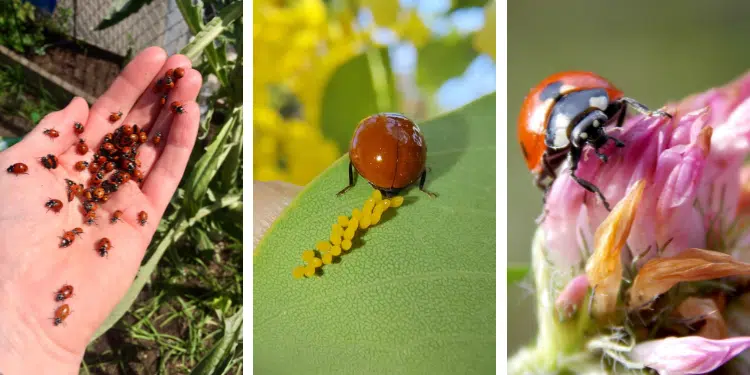
In the delicate theater of the organic garden, there is no protagonist more beloved or more efficient than the ladybug.
While they may look like delicate, polka-dotted gems crawling across a leaf, ladybugs – specifically the Convergent Lady Beetle (Hippodamia convergens) – are among the most voracious apex predators in the insect world.
If you have ever struggled with an aphid infestation that turned your lush rosebushes into sticky, shriveled messes, you know the frustration of “pest pressure.”
Most gardeners reach for a bottle of insecticidal soap or, worse, a synthetic pesticide. However, these chemical “solutions” often kill the beneficial insects along with the pests, creating a biological vacuum that leads to even worse outbreaks later.
The secret to a self-sustaining, pest-free garden isn’t a chemical – it’s a biological army. A single ladybug can devour up to 5,000 aphids in its lifetime.
The Biology of a Predator: Why Ladybugs are Essential
To understand why ladybugs are so effective, we must look at their lifecycle. Most people recognize the adult beetle, but the real “aphid-eating machines” are the larvae.
The Larvae Phase: The “Alligator” of the Garden
Ladybug larvae look nothing like the adults. They resemble tiny, black-and-orange armored alligators. They are extremely active and significantly more aggressive than the adults.
In the larval stage alone, a single insect can consume several hundred aphids before pupating. If you see these “alligators” in your garden, do not kill them! They are your frontline infantry.
The “Beneficial” Diet
While ladybugs are famous for eating aphids, they are actually generalist predators. They also feast on:
- Spider Mites: The tiny pests that weave webs and suck the life out of indoor and outdoor plants.
- Mealybugs: The fuzzy white pests common on tropicals and succulents.
- Scale Insects: The hard-shelled pests that cling to woody stems.
- Whiteflies: The tiny “moths” that swarm when you brush against a leaf.
The Secret Ingredient: Why Ladybugs Need Flowers
A common mistake gardeners make is assuming ladybugs only need “meat” (pests). In reality, ladybugs require pollen and nectar to survive and, more importantly, to reproduce.
Pollen provides the protein and fats necessary for the females to develop healthy eggs. If your garden has plenty of aphids but no flowers, the ladybugs will eat the aphids and then fly away to find a more “balanced” habitat to lay their eggs.
By planting the following eight flowers, you are providing a permanent “resort” for your ladybug army.
1. Calendula (Calendula officinalis)
Often called “Pot Marigold,” Calendula is a powerhouse in the organic garden. Its bright orange and yellow petals are a beacon for beneficial insects.
Why ladybugs love it:
Calendula produces an abundance of sticky resin and accessible pollen. It is also a fantastic “trap crop” for aphids.
The aphids are often attracted to the succulent stems of the Calendula, which in turn provides a concentrated “buffet” for the ladybugs. This keeps the pests off your more prized vegetables while keeping the predators fed and happy.
2. Dill (Anethum graveolens)
Dill is an essential herb for the kitchen, but its umbrella-shaped flower clusters (umbels) are the real star in the garden ecosystem.
Why ladybugs love it:
Ladybugs have relatively small mouthparts. They prefer tiny, shallow flowers where the nectar is easily accessible.
The flat, wide landing pads of dill flowers are perfect for ladybugs to land on and feast. Dill also attracts hoverflies and lacewings, which are secondary beneficial predators that work alongside ladybugs.
3. Cosmos (Cosmos bipinnatus)
Cosmos are the “easy-mode” flower for any gardener. They are drought-tolerant, prolific bloomers, and can reach impressive heights in a single season.
Why ladybugs love it:
Cosmos have an open-faced structure that makes the central pollen disc extremely easy for ladybugs to reach. Because
Cosmos bloom continuously from early summer until the first frost, they provide a reliable, long-term food source that encourages ladybugs to stay for the entire season.
4. Alyssum (Lobularia maritima)
Sweet Alyssum is a low-growing, honey-scented groundcover that acts as a “living mulch.”
Why ladybugs love it:
The dense, carpet-like growth of Alyssum provides a cool, moist microclimate where ladybugs can hide from the midday sun and avoid larger avian predators.
Because it blooms so profusely, it creates a constant scent trail that draws ladybugs in from miles away. It is particularly effective when planted at the base of “heavy feeders” like tomatoes and peppers.
5. Yarrow (Achillea millefolium)
Yarrow is a rugged perennial with feathery foliage and flat-topped flower clusters. It is one of the most reliable plants for attracting “The Big Three” of beneficials: ladybugs, lacewings, and parasitic wasps.
Why ladybugs love it:
Like dill, yarrow’s structure allows dozens of ladybugs to feed on a single flower head simultaneously.
Yarrow is also a “dynamic accumulator,” meaning its deep roots pull up minerals that improve the overall health of your soil, making your entire garden more resilient to pest attacks from the ground up.
6. Cilantro/Coriander (Coriandrum sativum)
Most gardeners get frustrated when their cilantro “bolts” (goes to seed) in the heat of summer. However, for a ladybug enthusiast, a bolting cilantro plant is a major victory.
Why ladybugs love it:
The delicate white flowers of bolted cilantro are incredibly rich in nectar. By letting a few of your herb plants go to seed, you are creating a high-energy snack bar for ladybugs.
The seeds themselves (coriander) can then be harvested for the kitchen, making it a dual-purpose win for the gardener.
7. Statice (Limonium sinuatum)
Statice is often used as a “dried flower” in bouquets, but it deserves a place in the soil for its ecological benefits.
Why ladybugs love it:
Statice flowers are remarkably sturdy and provide a stable platform for ladybugs to mate and lay eggs. The tiny, funnel-shaped flowers offer a concentrated source of nectar that keeps adult ladybugs energized for their grueling aphid-hunting patrols.
8. Fennel (Foeniculum vulgare)
Bronze fennel is a beautiful, architectural plant that can reach heights of five feet or more, adding “vertical interest” to the back of the garden border.
Why ladybugs love it:
Fennel is perhaps the single best plant for attracting a wide diversity of beneficial insects. Its yellow umbels are identical in function to dill but typically bloom slightly later in the season, ensuring there is no gap in your garden’s nectar supply during the hottest months.
3 Pro-Tips for a Ladybug-Friendly Garden
Planting the flowers is the first step, but to truly fix your pest frustrations, you must follow these three fundamental rules of organic gardening:
1. The 10% Pest Rule
If you see a few aphids, do not panic. Ladybugs will not stay in a garden that is 100% clean. They need a “base population” of pests to feed on and a reason to lay their eggs.
Allow a small amount of damage on your plants to serve as the “bait” that keeps your predators from moving to the neighbor’s yard.
2. Ditch the “Cides”
Even organic pesticides like Neem oil or insecticidal soaps can harm ladybug larvae. If you must treat a plant, try a “hard blast” of water from a hose first.
This physically knocks aphids off the plant (where they usually cannot climb back up) without harming the beneficial beetles or leaving toxic residues.
3. Provide “Ladybug Housing”
Ladybugs love to overwinter in leaf litter, hollow stems, and mulch. If you “clean up” your garden too thoroughly in the fall, you are inadvertently removing the hibernating army for next year.
Leave a small patch of “mess” in a corner of the garden to provide them with a safe winter home.
A healthy garden isn’t a sterile environment; it is a balanced ecosystem. By planting Calendula, Dill, Cosmos, Alyssum, Yarrow, Cilantro, Statice, and Fennel, you are doing more than just beautifying your yard. You are building a fortress where ladybugs can thrive, reproduce, and protect your plants.
Remember: one ladybug can devour 5,000 aphids. By inviting them in with the right flowers, you are letting nature do the hard work for you.