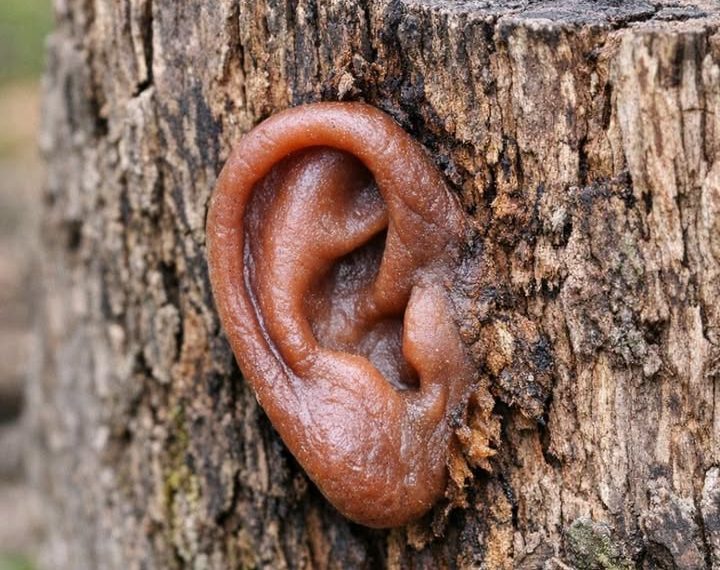
If you’ve ever been out in the yard with a cup of coffee, glanced over at an old stump, and nearly jumped because it looked like a little brown ear was growing out of the wood, you are definitely not alone. The first time I saw one tucked into a damp pile of branches behind our shed here in the Midwest, I stopped in my tracks. It really did look unsettlingly human at first glance. The good news is that in most cases, that odd rubbery growth is a type of jelly fungus commonly called wood ear, and it is usually more fascinating than frightening.
In this article, I’m going to walk through what wood ear fungus looks like, why it shows up on old stumps and logs, whether it’s dangerous to people, pets, or living trees, and what you should do next. I’ll also share a few practical yard tips, a couple of cautions, and how to tell when a strange growth is worth a closer look from a local extension office or mushroom expert.
1. What it probably is
A rubbery, brown, ear-shaped growth on dead or decaying wood is very often wood ear fungus, a group of fungi in the genus Auricularia. Depending on the species, it may also be called jelly ear, tree ear, or black fungus. These fungi form thin, flexible fruiting bodies that can be anywhere from about 1 inch to 4 inches across, though clusters can cover a much larger patch of a stump or fallen branch.
What makes people do a double take is the shape. Many fruiting bodies are cupped, folded, or wrinkled in a way that truly resembles an ear. The surface can be smooth to lightly fuzzy, and the texture is often gelatinous when wet and leathery when dry. Color ranges from tan and reddish brown to deep brownish black.
2. Why it looks so much like a real ear
Wood ear has a soft, pliable structure that bends and curls as humidity changes. After a rain, it can swell and become almost translucent at the edges, with folds and ridges that mimic the curves of an outer ear. In dry weather, it shrinks, darkens, and toughens, sometimes looking more like dried fruit leather attached to bark.
That shape is not random. As the fungus grows outward from the wood, the edges often roll and cup. On a stump that’s 10 inches to 24 inches across, you might see one single “ear” or a shelf-like cluster of 6 to 20 overlapping ones. It’s one of those things in nature that seems oddly designed, even though it’s simply the way the fungus develops.
3. Where it usually grows
Wood ear almost always grows on dead, dying, or heavily decaying wood. Old hardwood stumps, fallen limbs, rotting logs, stacked firewood, and brush piles are common spots. I most often notice it on shady sides of wood where moisture lingers longer, especially after 0.5 to 1 inch of rain followed by a few cool, humid days.
It prefers wood that’s already breaking down. So if it’s on an old stump in the yard, the fungus is not creating a brand-new problem as much as taking advantage of one that already exists: dead wood is decomposing. That is part of nature’s cleanup crew at work.
4. Is it something to worry about?
For most homeowners, the answer is no, not in any urgent sense. Wood ear fungus on an old stump is usually not a threat to healthy people from casual contact, and it is not the kind of thing that means your whole yard is in danger. It does mean the wood is decaying, but if the stump is already old and dead, that’s expected.
The bigger “worry,” if there is one, is practical rather than scary. A decaying stump can attract insects, stay damp, and become a tripping hazard or mower obstacle. If the stump is close to a walkway, patio, or play area, you may want to remove it for convenience and safety. But the fungus itself is generally not a sign of a toxic emergency.
5. Is it dangerous to touch?
Most people can touch wood ear without any issue, especially briefly while inspecting it. It may feel cool, slick, rubbery, or a bit like firm gelatin. That said, I still suggest wearing garden gloves if you’re handling any wild fungus. Gloves keep your hands clean, reduce the chance of irritation from dirt or mold on the wood, and help you avoid rubbing your eyes afterward.
As with any mushroom or fungus, don’t let children treat it like a toy, and wash hands after contact. If someone has a mold allergy, asthma, or a very sensitive immune system, it’s smart to avoid disturbing clusters unnecessarily, especially dry ones that can shed bits of debris when broken.
6. Is it harmful to pets or kids?
The main concern with pets and young kids is not that wood ear is notorious for causing poisoning from a glance or a touch. The concern is ingestion. Lots of wild fungi are hard for non-experts to identify with confidence, and yard mushrooms should never be treated like snacks. If you have a dog that chews sticks, digs in mulch, or mouths anything squishy in the yard, remove accessible fungi and supervise outdoor time.
For families, my rule is simple: look, don’t taste. If a child or pet has eaten any wild mushroom or fungus, call Poison Control or your veterinarian right away and, if possible, take clear photos from above, below, and the side with a ruler or coin for size. That can save precious time if identification is needed.
7. What it says about the stump itself
Wood ear is a decomposer. It feeds on the compounds in dead wood, helping break them down over months and years. If your stump is sprouting wood ear, the stump likely has plenty of retained moisture and internal decay. A stump that is 12 inches wide may take several years to soften significantly, while a larger hardwood stump 24 to 36 inches across can persist much longer.
In other words, the fungus is telling you the stump is still biologically active even though the tree is gone. If you were already thinking about stump grinding, this is one more clue that the wood is on its way toward rot. If you prefer a tidier yard, that may push removal higher on your list. If the stump is tucked away near a fence line, you may decide to simply let nature finish the job.
8. Can it spread to healthy trees?
In most situations, wood ear is associated with dead or severely weakened wood, not vigorous healthy trees. Finding it on an old stump does not usually mean your healthy maple, oak, or ash 20 feet away is about to become infected. Fungi like this are opportunists that colonize material already suitable for decay.
That said, if you see similar growths emerging directly from wounds on a living tree trunk, from exposed roots, or from large broken limbs still attached to the tree, it may be worth having an arborist take a look. The issue there is less “wood ear panic” and more checking whether the tree has dead sections, cavities, or structural weakness.
9. When it appears and disappears
One of the reasons this fungus seems mysterious is that it changes fast with the weather. After a damp spell, it can plump up within 24 to 72 hours and look freshly formed. Then a stretch of hot, dry weather can make it shrivel down so much that you barely notice it. A cluster that measured 3 inches across when wet might contract to half that size when dry.
Here in the Midwest, I tend to notice jelly fungi most often in spring and fall, when temperatures are roughly 45 to 70 degrees Fahrenheit and humidity stays up. But if summer is rainy and shaded, or winter is mild, they can show up then too.
10. How to tell wood ear from other odd fungi
Wood ear typically has these clues: ear-like or cup-like shape, brown to dark brown color, jelly-rubbery texture when moist, and growth directly from wood. It usually does not have a distinct stem like a classic cap mushroom. The underside is generally smooth rather than lined with gills.
Other jelly fungi can also be brown, amber, yellow, or black, so identification is not always simple from one glance. If the growth is bright orange, sulfur yellow, powdery, strongly foul-smelling, or growing from soil instead of wood, you may be looking at something else. A local cooperative extension office, native plant group, or mushroom club can often help with identification from a few sharp photos.
11. Should you remove it or leave it alone?
If the stump is out of the way, you can safely leave the fungus alone. It will continue helping decompose the wood. Some folks enjoy watching the little changes from week to week, especially after rain. Nature has a way of turning even a plain old stump into something interesting.
If it bothers you visually, if children play nearby, or if you simply want a cleaner yard, you can remove the visible fruiting bodies with gloved hands or a small trowel. Just know that this does not “cure” the stump. The fungal network is inside the wood, so as long as the stump stays damp and decayed, it may fruit again after the next wet period.
12. The best way to get rid of it for good
To truly stop wood ear from returning, you need to remove the food source: the decaying wood. That usually means stump grinding, full stump removal, or allowing the stump to completely decompose over time. Stump grinding commonly takes a stump down 4 to 12 inches below grade, depending on the equipment and service. In many towns, the cost can range from around $100 for a small stump to $300 or more for larger ones.
You can also speed decay naturally by keeping the stump cut low and allowing weather, insects, and fungi to do their work, but that is a slow approach. For a family yard where mowing space matters, I usually think removal is worth it if the stump sits in a high-traffic area.
13. If you’re curious: yes, some wood ear fungi are edible, but be careful
Some species of wood ear are widely eaten in soups, stir-fries, and salads, especially in Asian cuisines, and they’re sold dried in grocery stores under names like black fungus or wood ear. But this is one of those places where I put on my mom voice a little: do not assume the thing on your stump is dinner just because the name sounds familiar.
Wild fungal identification needs real confidence, and yard conditions matter. A stump may have been treated with chemicals years ago, exposed to pesticides, or contaminated by pet waste or runoff. Even edible species are best eaten only when positively identified and harvested from clean, appropriate locations. If you’re interested in foraging, learn with a local expert in person before tasting anything.
14. When to call in an expert
You probably do not need help for a single cluster on an old stump. But it’s smart to get advice if the fungus is growing from a living tree, if the tree has large dead limbs overhead, if the trunk has cavities or soft spots, or if mushrooms are appearing near the base of a tree that leans toward the house or driveway.
For identification questions, take 3 to 6 clear photos: one wide shot showing the stump, one close-up of the top, one of the side, one of where it attaches to the wood, and one with a ruler or coin for scale. Note whether it was found after rain, whether it was slimy or dry, and what kind of tree the stump came from if you know. Those details help a lot.
15. My practical backyard bottom line
If that strange little “ear” is growing on an old stump, the most likely explanation is a wood ear fungus, and in most cases it is not something to panic over. It’s nature recycling dead wood. Keep kids and pets from eating it, wear gloves if you handle it, and decide whether the stump belongs in your yard long-term.
Personally, I’d leave it alone if it were in a shady back corner and just enjoy the oddity of it. If it were near the patio where my family walks every day, I’d put stump grinding on the weekend to-do list and call it a day. Sometimes the weirdest things in the yard turn out not to be dangerous at all, just one more reminder that life keeps growing in all sorts of unexpected places.