I used VapoRub the way my mother did for years: a swipe under the nose, a spoonful in a bowl of hot water, and another dab whenever I felt like I needed it. Then I finally read the label closely and realized a lot of the “old family ways” are exactly what you’re not supposed to do.
If you want the comfort of VapoRub at night, the right method is much more specific than most of us were taught. Here are 16 rules I wish I’d known sooner, including where to put it, how much to use, what to never do, and when it’s time to stop treating it like a simple bedtime fix and call a doctor.
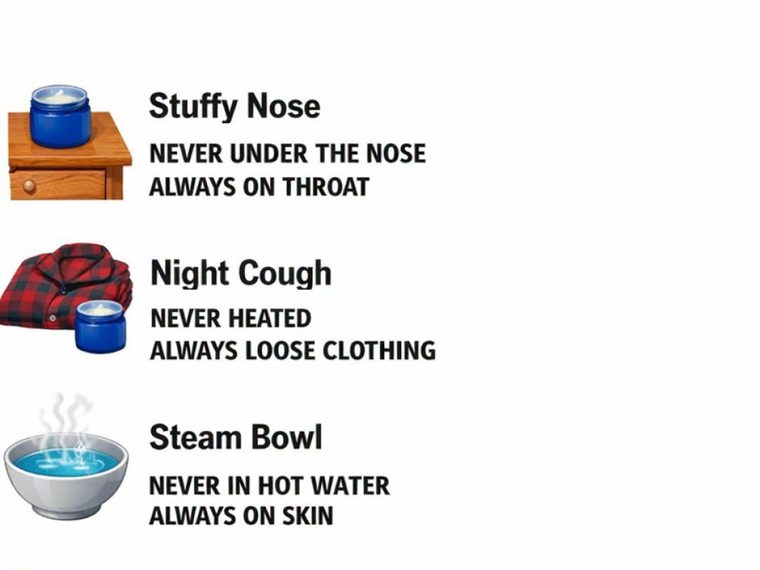
1. For a stuffy nose, never put it under or in your nose—put it on your throat
This is the big one most of us got wrong. The label says not to apply VapoRub in or near the nostrils, and there’s a real reason: camphor can irritate the delicate lining inside the nose. You do not need it that close to breathe in the vapors. A thick layer on the front of the throat works just as well because the vapors rise up toward your nose as you rest.
What I do now is apply it over the lower throat area, from just below the chin down a few inches toward the collarbone, then let a loose pajama collar sit over it. The honest exception is none: if the question is “under the nose or on the throat,” the right answer is throat every time.
2. For a night cough, never heat it—use it under loose clothing
Plenty of people think warmth “activates” it, but the label warns against heating VapoRub or using it with a heating pad. Extra heat can increase irritation and raises the risk of burns when people start improvising. For bedtime coughing discomfort, apply it to the throat and upper chest, then wear a loose T-shirt, nightgown, or pajama top so the vapors can drift upward.
Loose is the key word here. You want airflow, not a sealed wrap. I aim for a soft cotton neckline that doesn’t press against the skin. The one honest exception is body warmth alone—that’s normal. Artificial heat is the part to skip.
3. Never put it in a bowl of hot water—put it on your skin instead
I know this trick is a classic, but it’s still the wrong one. The label warns against using VapoRub in hot water because hot liquid can spatter, the container can get slippery, and steam setups can lead to burns. A bedside steam bowl sounds harmless until you picture hot water in dim light at 10 p.m.
If your goal is the vapor, apply it directly to the skin where it was designed to be used: throat and chest. That gives you the scent and cooling sensation without the burn risk. The honest exception is none: not in a mug, not in a bowl, not in a humidifier reservoir.
4. For sore muscles, never keep reapplying all day—3 times a day maximum
When you’re using VapoRub as an external analgesic for minor aches, more is not better. The label allows up to 3 applications daily. That means morning, late afternoon, and bedtime is reasonable; every 2 hours is not. Camphor exposure adds up, and frequent reapplication can irritate the skin without giving better relief.
I think of it as spacing doses by at least 6 to 8 hours. Use enough to cover the sore area, wash your hands, and let it sit. The honest exception is that “less often” is fine; “more than 3 times” is where the line is.
5. Don’t use a tiny fingertip smear—use a thick coat on the throat area
Most of us under-apply it, especially if we’re trying to “make the jar last.” For nighttime comfort, use a thick coat over the throat area, not a pinhead dab or a quick streak. Think enough to visibly cover the skin in a thin opaque layer over an area about the width of your neck and 2 to 3 inches down.
Rub it in for a few seconds—about 5 to 10 is enough—so it spreads evenly, but don’t massage until the skin is nearly dry. You want a real layer on the surface. The exception is only size: a petite neck needs less than a broad chest, but a token smear usually isn’t enough to do much.
6. Socks over VapoRub on your feet may feel nice, but it is not a fix for congestion
I know this one is beloved. Rubbing VapoRub on the feet and pulling on socks can feel soothing, warm, and oddly comforting at bedtime. I’ve done it myself. But there is no solid proof that putting it on the feet opens a stuffy nose or treats a cough.
If you like the ritual, use it for comfort and call it that. A light coating on clean feet with cotton socks can feel cozy, especially in winter, but don’t treat it as a substitute for using it correctly on the throat and chest. The honest exception is comfort: that part is real, even if the congestion claim isn’t proven.
7. For toenails, use it daily on a clean, dry nail for months—and keep expectations realistic
Some people use VapoRub on thick or discolored toenails, and there are small reports suggesting it may help appearance over time. But this is not a proven, strong treatment, and it is definitely not quick. If you try it, apply a small amount once daily to a clean, fully dry nail, including along the nail edge, and keep doing it for months, not days.
I’d trim and file the nail normally, wash and dry the foot thoroughly, then use just enough to coat the nail surface. Expect slow change, if any, over 3 to 6 months as the nail grows out. The honest exception is patience: if you want certainty or the nail is painful, that’s a doctor conversation, not a jar-of-rub solution.
8. Never swallow it
This is an absolute, and it needs to stay one. VapoRub is for external use only. Camphor is toxic when swallowed, and even a small amount can be dangerous. It is not a “home remedy” to take by mouth, add to tea, or lick from a spoon. I’m blunt about this because old remedies have a way of getting passed around casually.
Keep the jar tightly closed and stored where children and confused adults won’t mistake it for something harmless. If anyone swallows it, call Poison Control right away rather than waiting to “see how they do.” There is no honest exception to this one.
9. Never use it on children under 2
Another absolute: VapoRub should not be used on children under age 2. The reason is not fussiness—it’s safety. Camphor and strong vapors can cause breathing trouble in very young children, whose airways are much smaller and easier to irritate.
If a household has grandchildren over, this is one of those jars that should be put away, not left on the nightstand. The honest exception is none under age 2. For older children, follow the age directions on the product label and stick to external use only.
10. Never put it on broken or irritated skin
VapoRub belongs on intact skin only. Do not use it on cuts, scrapes, rashes, windburned skin, freshly shaved areas, or skin that is already irritated. Broken skin absorbs more, stings more, and reacts more easily to camphor, menthol, and eucalyptus oil.
If the skin is cracked or inflamed, wait until it has settled down before using any chest rub there. The honest exception is none if the skin barrier is broken. If you wouldn’t put perfume on that spot, don’t put this there either.
11. Never get it in or near your eyes, and wash your hands after applying
This sounds obvious until you forget and rub your eye 30 seconds later. VapoRub should never go in or near the eyes because the ingredients can cause intense burning and irritation. That also means don’t apply it high on the cheeks or close to the lower eyelids in hopes of “opening everything up.”
As soon as you finish applying it, wash your hands well with soap and warm water for at least 20 seconds, including under the nails. If you use it right before bed, that hand-washing step matters even more because sleepy people touch their faces without thinking. The honest exception is none: hands washed, every time.
12. If you cover it, use a warm, dry cloth loosely
This is the one exception that surprises people: the label allows a warm, dry cloth over the area. If that feels soothing, keep it simple—warm, dry, and loose. Think of a freshly warmed flannel laid gently over the chest or throat for a few minutes, not tucked in tightly and not reheated against the skin.
The cloth should feel comfortably warm, never hot, and it should not trap pressure. I’d use a clean dry washcloth or thin hand towel and remove it if the area starts to feel prickly. The honest exception here is the cloth itself: a loose warm dry covering is allowed, but that does not mean any heated setup is fine.
13. Never use a tight bandage or wrap over it
People sometimes think a snug wrap will “hold in the vapors,” but tight bandages trap heat and can irritate the skin. They also increase the chance that you’ll feel too much burning or discomfort during the night. VapoRub is not meant to be occluded under a firm wrap.
If you want coverage, choose loose clothing or that loose warm dry cloth—not an elastic bandage, compression wrap, or tightly tied scarf. The honest exception is none when it comes to tight wrapping. Loose is helpful; tight is a mistake.
14. Replace old jars that have dried out or lost their smell
A jar can last a long time, but not forever in useful condition. If the ointment has dried, separated, turned grainy, or lost much of its familiar smell, replace it. A fresh jar spreads more evenly and gives the expected vapor. An old one that smells faint and feels waxy is not doing you favors.
I check mine at the start of cold season. If it no longer has that strong menthol-camphor scent when I open it, or if it looks hardened around the edges, I buy a new jar. The honest exception is a jar that’s still fresh in smell and texture and within date—then use it normally.
15. Stop using it if your skin turns red or starts to sting
A mild cool or tingly sensation is one thing. Redness, burning, or stinging is another. If your skin starts reacting, wash the area gently with mild soap and lukewarm water and stop using the product. Reapplying on irritated skin usually makes the problem worse, not better.
This is especially common if someone has used too much, applied it too often, or covered it too tightly. The honest exception is the expected cooling sensation without visible irritation. Once the skin looks red or feels sharp and stingy, you’re done with that application.
16. See a doctor if a cough lasts more than 7 days or comes with fever
VapoRub can be comforting, but it does not diagnose anything and it does not replace medical care. If a cough lasts more than 7 days, keeps coming back, or shows up with fever, it’s time to call a doctor. The same goes for wheezing, shortness of breath, chest pain, or symptoms that are getting worse instead of better.
This is one more place where I think women over 50 tend to “wait it out” longer than we should. Comfort care has its place, but a week-long cough with fever deserves more than another bedtime rub. The honest exception is none when those warning signs are present.
Used correctly, VapoRub can still earn its spot on the nightstand—but the old habits many of us learned are not the safe ones. Read the label, use a real amount in the right place, and let it be a comfort measure rather than a cure-all.