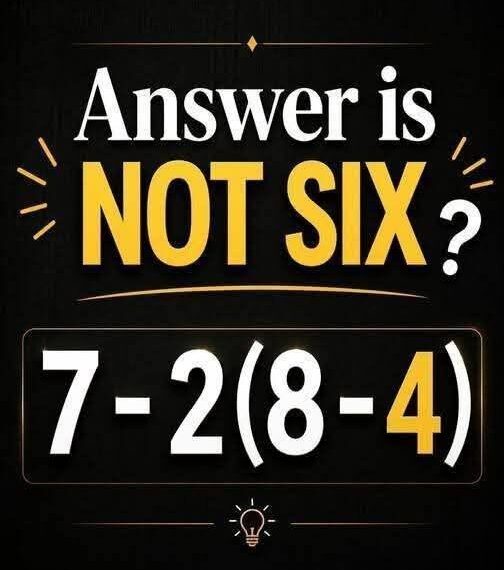
You’ve likely scrolled past it: a seemingly straightforward equation posted online with captions like “99% fail this!” or “Only geniuses get it right.” The problem looks simple at first glance:
8 ÷ 2(2 + 2) = ?
Yet the comment sections ignite. Two answers emerge — 16 and 1 — each defended with fierce conviction. People cite calculators, teachers, YouTube tutorials, and even academic credentials. So what’s really happening here?
Why This “Trap” Works
This isn’t a typical math problem. It’s a test of ambiguous notation combined with social psychology. At its core is the order of operations, commonly taught as PEMDAS or BODMAS:
- Parentheses / Brackets
- Exponents / Orders
- Multiplication & Division (evaluated left to right)
- Addition & Subtraction (evaluated left to right)
Applying Modern Conventions
For the equation:
8 ÷ 2(2 + 2)
- Solve inside the parentheses first: 2 + 2 = 4
- The equation becomes: 8 ÷ 2 × 4
- Evaluate multiplication/division from left to right:
- 8 ÷ 2 = 4
- 4 × 4 = 16
✅ Correct answer according to standard conventions is 16.
Why Some People Say “1”
The confusion arises from interpreting 2(4) as a single unit, leading to:
8 ÷ (2 × 4) = 8 ÷ 8 = 1
This is incorrect under modern left-to-right multiplication/division rules but demonstrates how notation ambiguity can trick even experienced solvers.
Lessons From This Viral Math Puzzle
- Pay attention to parentheses: They dictate what to calculate first.
- Follow the standard order of operations: Multiplication and division are done left to right, not automatically grouping numbers with parentheses in unusual ways.
- Check ambiguous expressions: If a problem seems unclear, clarify notation before solving.
- It’s okay to discuss: Different interpretations can spark debates, but math conventions exist for consistency.
Final Takeaway
The viral math trap isn’t about intelligence — it’s about understanding notation and order of operations. A simple misreading can lead to wildly different answers. Always solve step by step and trust standard mathematical rules.