For many gardeners, a deeply shaded backyard or a north-facing border is viewed as a landscaping problem. It is easy to assume that a lack of direct, blazing sunlight dooms a garden to look drab, bare, or perpetually muddy.
However, botanical evolutionary design reveals a magnificent library of plants uniquely adapted to life beneath forest leaf canopies.
Shade-loving perennials do not just survive without direct sun; they actively thrive in it. Instead of relying on short-lived, brilliant blossoms, these woodland powerhouses focus on intricate leaf architectures, variegated patterns, and multi-layered textures that bring deep, architectural interest to your garden year after year.
The Biological Engine: How Shade Perennials Process Low Light
To design a successful shade garden, you have to understand how these plants operate beneath the canopy.
Plants adapted to full sun feature thick, leathery leaves with a high density of cellular layers designed to withstand intense light radiation.
Shade perennials possess an entirely different cellular architecture:
- Expanded Leaf Surface Area: Shade-dwelling perennials develop remarkably broad, thin leaf blades. This maximized surface area acts like a biological solar panel, capturing every stray, fleeting photon of light that filters down through the upper tree branches.
- Exploded Chloroplast Dispersion: Inside the cells of a shade plant, the chloroplasts (the microscopic organelles responsible for performing photosynthesis) are spread out widely in a thin, single-layer grid rather than stacked tightly. This layout ensures that low-energy light waves can easily hit every single chlorophyll molecule, maximizing food production in dim environments.
- The Chemical Antifreeze Layer: Because damp, shady corners stay cooler and retain moisture much longer than sun-baked soils, many shade perennials are packed with high concentrations of natural sugars and anthocyanins. These compounds lower the freezing point of the plant’s sap, making them exceptionally tough and cold-hardy through harsh winter freezes.
15 Elite Shade Perennials for Visual Texture and Architecture
1. Hostas (Hosta spp.)
The undisputed anchor of the shade garden. Hostas are prized primarily for their spectacular, mounding foliage, which ranges from tiny, teacup-sized miniatures to massive, four-foot-wide structural giants.
- Visual Profile: Leaves come in a stunning spectrum of colors, including powdery blue-gray, bright chartreuse, and deep forest green, often finished with striking creamy-white variegated borders. In midsummer, they push up tall flower spikes bearing pale lavender, bell-shaped blossoms.
- Light Requirement: Dappled shade to deep, heavy shade. Gardener’s Rule: As a general rule of thumb, blue-leaved hostas require the deepest shade to preserve their waxy coating, while variegated and chartreuse varieties can tolerate a bit of morning sun without scorching.
2. Bleeding Heart (Lamprocapnos spectabilis)
A timeless, cottage-garden classic that introduces an unmatched element of whimsical, architectural romance to dark garden corners in the early spring.
- Visual Profile: Features arching, elegant, wand-like stems from which hang dozens of perfectly formed, two-toned pink and white blossoms shaped precisely like tiny, dripping hearts. The foliage is soft, deeply cut, and fern-like.
- Light Requirement: Partial to full shade. Note: Bleeding Heart is an ephemeral plant; it completely dies back and disappears underground by midsummer to escape the heat, so plant it next to late-emerging hostas that will naturally fill the empty space.
3. Astilbe (Astilbe spp.)
If you want to inject architectural texture and striking, feathery color into a damp, dark border, astilbes (commonly known as False Spirea) are the premier choice.
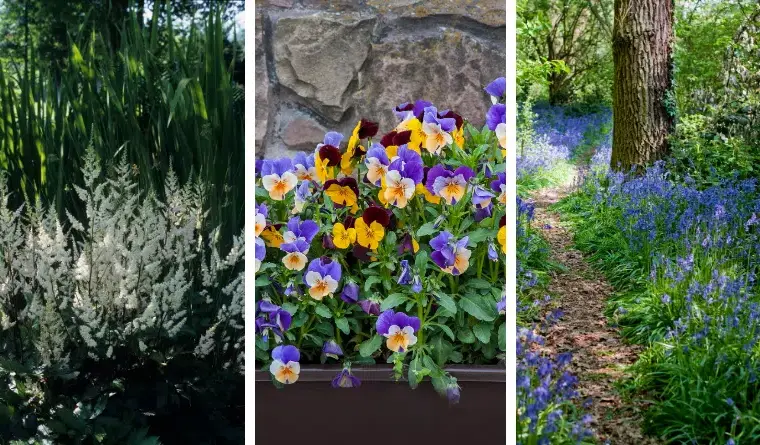
- Visual Profile: Pushes up dense, deeply divided, fern-like foliage that stays clean all season. In early-to-mid summer, the plants are topped with stiff, erect, plume-like flower spikes that look like soft feathers. They come in intense shades of crimson red, candy pink, soft lavender, and crisp white.
- Light Requirement: Partial to deep shade. Astilbes require consistently moist, organic-rich soil; if the ground dries out completely, their leaf margins will crisp and curl.
4. Coral Bells (Heuchera spp.)
Coral Bells are cultivated almost exclusively for their astonishing, kaleidoscopic leaf color palette, providing vivid color blocks across the garden floor from early spring through frost.
- Visual Profile: The ruffled, heart-shaped leaves come in an array of dramatic shades, including metallic silver, deep plum-purple, bright lime-green, copper-orange, and rich caramel. In late spring, they send up delicate, wispy, 2-foot-tall stems loaded with tiny, bell-shaped flowers that hummingbirds love.
- Light Requirement: Partial shade to open, filtered woodlands. The dark purple and copper varieties maintain their best color intensity when given a brief splash of gentle morning sun.
5. Lenten Rose (Helleborus orientalis)
Hellebores are the ultimate champions of late-winter and early-spring longevity. They are often the very first perennials to bloom, frequently pushing their thick flower buds straight up through melting snow blankets.
- Visual Profile: Features thick, leathery, dark evergreen leaves arranged in a structural rosette. The long-lasting, nodding, cup-shaped flowers come in moody, antique shades of dusty rose, deep maroon, slate gray, cream, and soft green.
- Light Requirement: Dappled woodland shade to heavy, full shade. They are exceptionally drought-tolerant once established and are entirely ignored by deer and rabbits due to their leathery texture.
6. Japanese Painted Fern (Athyrium niponicum)
While all ferns excel in shady environments, the Japanese Painted Fern stands out as a living piece of fine watercolor art, brightening up the darkest corners of the garden floor.
- Visual Profile: The highly delicate fronds grow in a low, arching rosette. They feature a striking metallic silver-gray body, heavily accented by deep burgundy-red central ribs and soft blue-green tips.
- Light Requirement: Full, deep shade. This fern requires protection from harsh afternoon light; even a brief blast of hot sun will quickly bleach out its unique silver and purple coloration.
7. Toad Lily (Tricyrtis formosana)
When most summer perennials begin to fade and look spent in late August and September, the exotic Toad Lily wakes up, providing a burst of intricate detail to the autumn shade garden.
- Visual Profile: Features clean, glossy, arching green leaves wrapped tightly around upright stems. The unique, star-shaped blossoms closely resemble tiny orchids, featuring a white-to-pale-lavender base that is heavily speckled with rich amethyst-purple spots.
- Light Requirement: Medium to full shade. It thrives beautifully in rich, moisture-retentive woodland soils and provides a wonderful late-season food source for native pollinators.
8. Solomon’s Seal (Polygonatum odoratum ‘Variegatum’)
An elegant, structural perennial that brings vertical height and graceful, arching lines to the middle or back of a shady border.
- Visual Profile: Pushes up long, gracefully curved, cane-like stems lined with soft green leaves finished with clean, creamy-white borders. In late spring, dozens of tiny, fragrant, white, bell-shaped flowers dangle delicately from the underscore of each stem like rows of pearls.
- Light Requirement: Full, deep shade. Solomon’s Seal spreads slowly via underground rhizomes, forming a dense colony over time that easily outcompetes weeds.
9. Lungwort (Pulmonaria spp.)
Lungwort is a fantastic, fast-growing, low-slung groundcover that offers outstanding multi-season value through its unique spotted foliage and early-spring flower display.
- Visual Profile: The long, lance-shaped leaves are covered in soft hairs and a pattern of bright silver-white spots that look like splashed paint. In early spring, it produces clusters of funnel-shaped blossoms that change color as they age, displaying bright pink and deep blue flowers simultaneously on the same stalk.
- Light Requirement: Medium to heavy shade. It handles dry shade conditions relatively well once its roots anchor deeply into the soil.
10. Foamflower (Tiarella cordifolia)
A highly rugged, native North American wildflower that serves as an exceptional, low-maintenance groundcover for stabilizing shady banks or creating living green pathways.
- Visual Profile: Heart-shaped, deeply lobed leaves that closely resemble maple leaves, often featuring striking dark burgundy accents running along the central veins. In spring, the foliage is topped by a cloud of airy, bottle-brush-shaped spikes of frothy white or pale pink flowers.
- Light Requirement: Deep shade to partial canopy cover. Foamflower spreads smoothly via runner stems, forming a thick, weed-blocking living mulch.
11. Siberian Bugloss (Brunnera macrophylla)
Commonly referred to as False Forget-Me-Not, Brunnera is a premium, large-leafed perennial that provides strong architectural lines and contrast when planted alongside fine-textured ferns.
- Visual Profile: Forms a neat mound of massive, distinct, heart-shaped leaves. Popular cultivars like ‘Jack Frost’ feature leaves that are completely coated in a heavy, solid metallic silver sheen, accented only by a network of thin green veins. In spring, air-light sprays of tiny, sky-blue blossoms rise above the foliage.
- Light Requirement: Full shade. The abrasive, sandpapery texture of the leaves makes them completely unpalatable to destructive garden pests like slugs, deer, and rabbits.
12. Wild Ginger (Asarum canadense)
A quiet, low-growing native perennial that functions as a beautiful, dense living carpet for the absolute darkest, most troublesome corners of your landscape.
- Visual Profile: Features broad, glossy, kidney-shaped or heart-shaped leaves that form a rich, velvety green mat just 6 inches off the ground. It hides unusual, dark purple-brown, three-petaled flowers tucked secretively right at the soil line beneath the leaf canopy.
- Light Requirement: Complete, deep shade. Wild Ginger loves organic, leaf-mold-rich woodland soils and spreads reliably to create a low-profile ground cover.
13. Columbine (Aquilegia spp.)
An airy, graceful native wildflower that acts as a vital bridge between early spring bulbs and summer perennials.
- Visual Profile: Delicate, blue-green foliage that resembles clover leaves. The highly intricate, nodding blossoms feature unique, long, backward-projecting nectar spurs. They come in an endless variety of bi-color combinations, including yellow-and-red, blue-and-white, and deep purple-and-cream.
- Light Requirement: Dappled shade to light partial shade. Columbines naturally self-sow, allowing them to gently drift across your garden beds over time, popping up in empty pockets where little else will grow.
14. Jacob’s Ladder (Polemonium caeruleum)
Prized for its exceptionally clean, architectural leaf arrangement, this perennial introduces a strong graphic texture to a soft fern or hosta bed.
- Visual Profile: Features long, compound leaves with pairs of small leaflets arranged horizontally like the rungs of a ladder. In late spring, loose clusters of soft, cup-shaped, sky-blue or lavender flowers with bright yellow stamens rise above the unique foliage.
- Light Requirement: Partial to medium shade. It prefers rich, consistently moist, well-draining soils and stays compact and tidy throughout the season.
15. Barrenwort (Epimedium spp.)
Also known as Bishop’s Hat, Epimedium is widely regarded by professional landscapers as the ultimate solution for the toughest, most challenging environment in gardening: dry shade beneath mature shallow-rooted trees.
- Visual Profile: Delicate, heart-shaped leaves carried on wire-thin stems that dance in the breeze. The leaves emerge with a bronze tint in spring, turn rich green in summer, and shift to a beautiful copper-red in autumn. The unique spring flowers resemble tiny, hovering spiders or bishop’s caps in shades of yellow, pink, and white.
- Light Requirement: Full shade to dense, dry shade. Once established, its tough, leather-like root network is incredibly drought-tolerant and can easily compete with mature tree roots for moisture.
Landscape Architecture & Design Matrix
To design a visually balanced shade garden, you want to blend contrasting leaf sizes, textures, and growth habits together. Use this matrix to select the perfect placement for your 15 perennials:
| Perennial Name | Growth Habit / Height | Unique Visual Highlight | Primary Landscape Utility |
| Hostas | Mounding / 1–4 Feet | Broad, colorful, variegated leaves | Structural anchor & focal point |
| Bleeding Heart | Arching / 2–3 Feet | Heart-shaped pink & white flowers | Early spring architectural romance |
| Astilbe | Upright / 1–3 Feet | Feathery, colorful flower plumes | Soft texture for damp borders |
| Coral Bells | Rosette / 1–2 Feet | Rich metallic, plum, & orange leaves | Vivid color blocks & bed borders |
| Lenten Rose | Structural / 1–2 Feet | Long-lasting winter & spring blooms | Year-round evergreen baseline |
| Japanese Painted Fern | Arching / 1–1.5 Feet | Metallic silver & burgundy fronds | Lightens dark corners; fine texture |
| Toad Lily | Upright / 2–3 Feet | Orchid-like spotted autumn flowers | Late-season interest for mid-bed |
| Solomon’s Seal | Arching / 2–3 Feet | Pearl-like dangling spring bells | Height & graceful lines for back-bed |
| Lungwort | Spreading / 1 Foot | Silver-spotted leaves; bi-color blooms | Early groundcover for path borders |
| Foamflower | Spreading / 1 Foot | Maple-like leaves; frothy white spikes | Living mulch for banks & pathways |
| Siberian Bugloss | Mounding / 1–1.5 Feet | Solid metallic-silver heart leaves | Strong leaf contrast; slug resistant |
| Wild Ginger | Groundcover / 0.5 Feet | Rich, velvety kidney-shaped leaves | Low-profile carpet for deep shade |
| Columbine | Airy / 1–2 Feet | Intricate, spurred bi-color flowers | Self-sowing naturalizer for drifts |
| Jacob’s Ladder | Upright / 1.5–2 Feet | Ladder-like horizontal leaf structure | Graphic texture for mid-bed balance |
| Barrenwort | Spreading / 1 Foot | Heart leaves; spider-like spring blooms | Conquers tough, dry shade zones |
A shady yard isn’t a landscaping limitation; it’s an open invitation to build a lush, peaceful, and deeply textured sanctuary.