Basil is one of the most popular herbs in the world – and for good reason. Its fresh, slightly sweet flavor is the star of pesto, caprese salad, and countless Mediterranean and Asian dishes.
But did you know the secret to harvesting endless basil all season long isn’t fertilizer, soil type, or variety? It’s pruning.
Most gardeners who struggle with basil end up with tall, leggy plants that flower too soon and stop producing leaves.
That’s because they’ve never learned the proper way to prune. With the right pruning techniques, you can transform a single basil seedling into a bushy, vibrant plant that produces nonstop leaves for months.
Why Pruning Basil Is the Secret to Endless Growth
Pruning isn’t about taking leaves here and there. It’s about redirecting the plant’s energy.
- Left unpruned, basil grows tall and sends its energy into producing flowers and seeds. Once it flowers, leaf production slows, and the flavor often turns bitter.
- Properly pruned, basil grows wider instead of taller. Every time you cut a stem, the plant produces two new shoots, doubling your potential harvest.
Think of pruning as coaching your basil: instead of letting it chase reproduction, you train it to keep focusing on leaf production.
The Science Behind Basil Pruning
Why does pruning work so well? The answer lies in plant hormones.
- Auxins: Concentrated at the tip of the basil stem, these hormones control apical dominance. They suppress growth from the side buds, telling the plant to grow upward.
- Cytokinins: Concentrated lower in the plant, these hormones stimulate lateral growth. But they stay dormant until auxins are removed.
When you cut off the top growth tip, you remove the auxin signal. This wakes up the dormant buds at the nodes below, and suddenly your plant starts branching out. Each cut = two new stems. Each new stem = double the leaves.
This is why consistent pruning is the difference between a single spindly stem and a lush basil bush.
Tools You’ll Need
You don’t need fancy equipment to prune basil. A few basics are enough:
- Sharp scissors or pruning shears – for clean cuts on thicker stems.
- Your fingers – for young, soft growth tips. Pinching works perfectly.
- Disinfectant (rubbing alcohol) – clean blades before pruning to avoid spreading disease.
- Basket or container – to collect fresh basil leaves for the kitchen.
When to Start Pruning Basil
Timing matters.
- Wait until your basil is 6–8 inches tall with at least 3–4 pairs of true leaves.
- Too early, and the plant won’t have enough energy to recover.
- Too late, and it may already start to flower and lose vigor.
Start early, prune often, and you’ll keep your basil productive all season long.
Step-by-Step Guide to Pruning Basil
Follow these steps for the perfect cut every time.
Step 1: Identify the Node
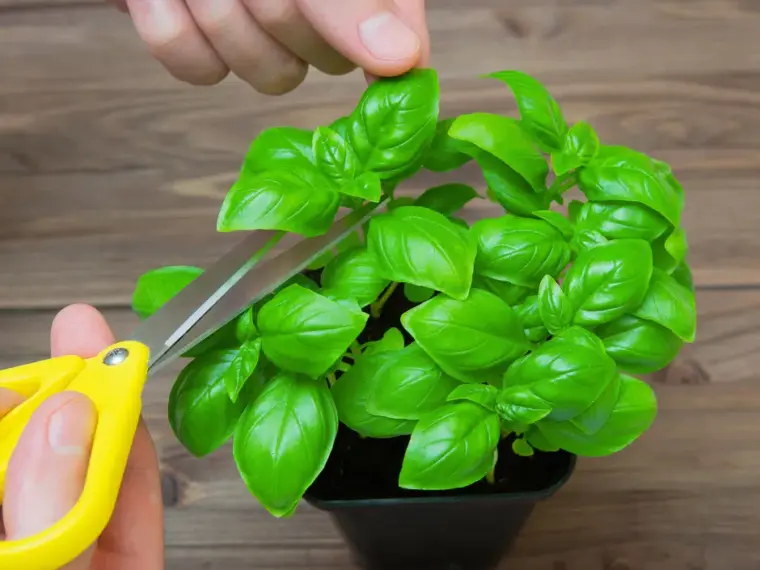
Find a stem that has at least four sets of leaves. Look where each pair of leaves meets the stem – those tiny shoots at the joints are called nodes.
Step 2: Cut Above the Node
Using scissors or your fingers, cut the stem about ¼ inch above a pair of leaves. Never cut below the node – that removes the growth point.
Step 3: Let Side Shoots Grow
Within a few days, the tiny shoots below your cut will start to grow into two new stems. Each one produces its own leaves.
Step 4: Repeat the Process
Once those new stems grow 4–6 inches tall, prune them the same way. Every cut doubles your growth again.
In as little as 4–6 weeks, one basil plant can turn into a full bush with 8–12 branches.
The 4-Inch Rule Trick
Instead of waiting until your basil is tall and leggy, make your first prune early – right when the plant reaches about 4 inches tall.
- At this stage, snip off the very top growth tip, just above the first true set of leaves.
- This small early cut signals the plant to branch sooner, creating a strong, bushy base instead of a tall single stalk.
- By the time the plant is 8–10 inches tall, you’ll already have a basil “bush” with multiple branches ready for further pruning.
Why it works: Early pruning removes apical dominance before the plant has invested too much energy in a central stem.
It forces the plant to redirect growth hormones into lateral shoots, doubling your harvest weeks ahead of schedule.
Visualizing the Cuts (Without Pictures)
- Imagine a basil stem with four pairs of leaves.
- Cut the stem just above the second pair.
- The top part goes into your kitchen.
- The lower part wakes up and produces two new branches.
- Repeat again, and those two become four, then eight, then sixteen.
That’s the math of basil pruning: each cut multiplies your future harvest.
The Beginner’s Mistakes Diary
Every gardener makes mistakes at first. Here are the most common basil pruning mistakes – and how to fix them.
Picking single leaves
- Problem: Weakens the plant and leaves bare stems.
- Fix: Harvest whole stems above a node.
Waiting too long to prune
- Problem: Basil grows tall and flowers early.
- Fix: Start pruning at 6–8 inches tall.
Cutting below a node
- Problem: Removes the growth points.
- Fix: Always cut just above the node.
Letting flowers stay
- Problem: Plant diverts energy to seeds, not leaves.
- Fix: Pinch off flowers as soon as they appear.
Over-pruning
- Problem: Cutting off more than one-third at once stresses the plant.
- Fix: Harvest little and often.
Not pruning indoor basil
- Problem: Indoor plants grow leggy without light and pruning.
- Fix: Provide bright light or grow lights, prune weekly.
Advanced Basil Pruning Techniques
Once you’ve mastered the basics, try these advanced methods.
Two-Thirds Harvest Method
Cut entire stems back by two-thirds when they reach 10–12 inches. This encourages vigorous regrowth and multiple new shoots.
Succession Pruning
Prune half the plant one week, the other half the next week. This ensures you never shock the plant and always have fresh leaves.
Propagation From Cuttings
Place pruned stems in a glass of water. In 7–10 days, they sprout roots. Plant them in soil to create new basil plants – free clones that extend your harvest.
How Often Should You Prune Basil?
- Light pruning every 7–10 days keeps basil compact.
- Heavier pruning every 2–3 weeks rejuvenates growth.
- Rule: never remove more than one-third of the plant at once.
Basil Varieties and Pruning Differences
Not all basil is identical. Here’s how to approach popular varieties:
- Sweet/Genovese basil – Prune aggressively for bushiness.
- Thai basil – Pinch flowers weekly; prune often to prevent legginess.
- Lemon basil & cinnamon basil – Grow fast but bolt quickly; prune consistently.
- Perennial basils (African blue) – Can grow woody; prune harder to maintain shape.
Basil Through the Seasons: A Pruning Calendar
Spring
- Begin pruning at 6–8 inches.
- Focus on shaping bushy growth.
- Fertilize lightly with nitrogen.
Summer
- Weekly pruning is essential.
- Pinch flowers constantly.
- Propagate cuttings for new plants.
Fall
- Take heavy harvests before frost.
- Root cuttings indoors to overwinter.
Winter (indoors)
- Grow under lights.
- Prune lightly to keep compact.
- Water sparingly in cooler months.
Troubleshooting Basil
- Leggy growth: Not enough pruning or light → prune harder, add more sun/grow light.
- Yellow leaves: Overwatering or nutrient deficiency → water less, feed lightly.
- Brown crispy tips: Underwatering → maintain consistent moisture.
- Black spots: Fungal disease → prune damaged leaves, avoid overhead watering.
- Aphids/whiteflies: Spray with neem oil or insecticidal soap.
Culinary Section: 10 Delicious Uses for Fresh Basil
Pruning basil gives you baskets of fresh leaves. Here’s how to use them.
- Classic Pesto Genovese – Blend basil, pine nuts, garlic, olive oil, Parmesan.
- Caprese Salad – Tomato, mozzarella, fresh basil, balsamic drizzle.
- Basil Butter – Mix chopped basil into butter; spread on bread or melt over veggies.
- Thai Basil Stir-Fry – Use Thai basil in spicy chicken or tofu stir-fry.
- Basil Oil – Blend basil with olive oil for pasta or bread dipping.
- Basil Tea – Steep fresh leaves with honey and lemon for calming tea.
- Herbal Ice Cubes – Freeze chopped basil in olive oil for quick cooking cubes.
- Tomato-Basil Soup – Fresh basil transforms simple tomato soup.
- Cocktails/Mocktails – Muddle basil into mojitos, lemonade, sparkling water.
- Basil Salt – Dry basil, blend with sea salt for seasoning meats and salads.
Frequently Asked Questions
Q: Should I pick individual leaves or whole stems?
Always cut stems above a node.
Q: How tall should basil be before first pruning?
6–8 inches.
Q: Can I prune too much?
Yes. Don’t remove more than one-third at once.
Q: Does pruning make basil taste better?
Yes. New leaves are sweeter and tender.
Q: Can I grow basil year-round?
Yes – indoors in pots with lights and regular pruning.
Pruning is the single most important skill for getting endless basil harvests. By cutting above nodes, starting early, and pruning often, you multiply your plant’s growth potential.
Instead of one tall stem, you’ll have a lush basil bush bursting with leaves. Each cut trains the plant to keep producing – and with proper care, you’ll enjoy fresh basil in your kitchen all season long.