The Christmas cactus (Schlumbergera) is one of the most rewarding indoor plants you can grow.
Unlike many houseplants, it offers not just greenery but spectacular seasonal blooms – often during the coldest, darkest time of the year.
But if your plant has started to look thin, uneven, or less productive, the issue is often simple: it needs pruning.
Many people think pruning is optional for a Christmas cactus. In reality, it is one of the most important care practices if you want a plant that is full, balanced, and covered in flowers year after year.
What makes this plant unique is that it actually gives you clear signals when pruning is needed. If you learn to recognize those signs early, you can correct problems before they affect flowering and overall health.
Understanding How Christmas Cactus Grows
Before recognizing the signs, it helps to understand how this plant develops.
A Christmas cactus grows in segments, and each segment has the ability to branch. When the plant is young or regularly pruned, it produces multiple branches from each point.
Over time, this creates a dense, cascading form filled with potential flowering sites.
However, when pruning is neglected, growth becomes uneven. Some stems continue to extend outward without branching, while others slow down. The plant begins to stretch instead of filling out.
This is why pruning is so powerful – it resets the growth pattern and encourages the plant to become fuller, stronger, and more productive.
1. The Plant Starts Looking Long, Thin, and Sparse
One of the first signs that your Christmas cactus needs pruning is a change in its shape. Instead of appearing full and rounded, it begins to look stretched out.
You may notice long stems hanging down with fewer segments than before. The plant may still be alive and growing, but it lacks density. It feels like the structure is weakening.
This happens because the plant is continuing to grow outward without being encouraged to branch. Each stem keeps extending, but without pruning, it doesn’t split into multiple directions.
Light can also play a role here. If the plant has been sitting in lower light conditions, it will stretch toward the available light source. But even in good light, lack of pruning leads to this elongated look.
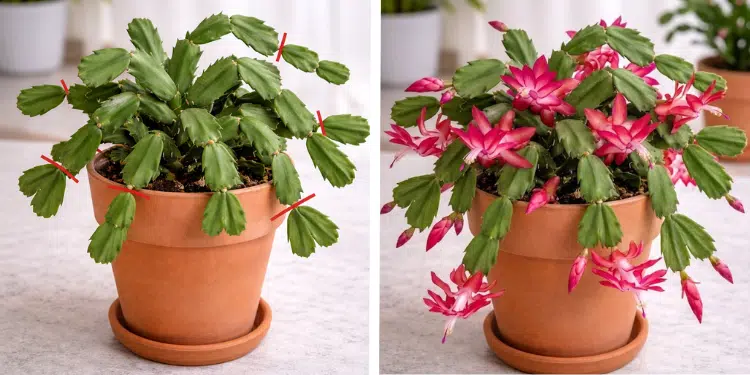
When you prune these longer stems, something important happens. Instead of continuing as a single line, each cut point becomes a branching site. New segments begin to form, and instead of one stem, you get two or more.
Over time, this transforms the plant from thin and stretched into compact and full.
2. Blooming Has Decreased or Become Inconsistent
A Christmas cactus that used to flower heavily but now produces fewer blooms is sending a clear signal.
Flower buds form at the tips of segments, particularly on newer growth. When a plant hasn’t been pruned, it produces fewer new segments, which means fewer potential flowering points.
The plant may still bloom, but the display becomes less impressive each year.
Pruning plays a direct role in restoring flowering. By encouraging new branches, you multiply the number of tips where buds can form. Each new segment becomes a future bloom site.
This is why well-maintained Christmas cacti often appear covered in flowers, while neglected ones produce only a few scattered blooms.
The connection is simple but powerful:
more branching leads to more growth points, and more growth points lead to more flowers.
3. The Center Becomes Dense and Overcrowded
In some cases, the issue is not lack of growth but poor distribution of it.
The outer parts of the plant may look healthy and vibrant, while the center becomes thick and crowded. Light struggles to reach the inner sections, and airflow becomes limited.
This environment can lead to several problems. The inner segments may weaken, growth may slow in those areas, and moisture can linger longer than it should.
Pruning in this situation is about balance rather than reduction. Removing a few inner stems opens up the plant, allowing light and air to circulate more evenly.
This improves overall health and encourages more uniform growth. Instead of having a dense center and thin outer edges, the plant begins to develop a more consistent, rounded shape.
4. New Growth Looks Smaller or Weaker Than Before
A healthy Christmas cactus produces firm, plump segments with a rich green color. When new growth appears smaller, thinner, or less vibrant, it’s often a sign that the plant is spreading its energy too thin.
Over time, an unpruned plant develops more stems than it can fully support. Instead of producing strong growth across all stems, it produces weaker growth across many.
This is where pruning becomes a way of redirecting energy.
By reducing the number of stems, you allow the plant to focus its resources on fewer growth points. The result is stronger, thicker segments and more vigorous development.
After pruning, many growers notice that new growth appears healthier, with better color and structure. The plant is no longer trying to maintain too much at once.
5. The Plant Becomes Uneven or Lopsided
Christmas cacti naturally grow toward light. If the plant has been sitting in one position for a long time, one side may become fuller while the other remains sparse.
This creates a lopsided appearance that becomes more noticeable over time.
While rotating the plant can help prevent this in the future, pruning is the fastest way to correct it once it happens.
By trimming back the heavier side, you restore visual balance. At the same time, the plant responds by producing new growth in multiple directions, helping to fill in the weaker areas.
Over time, the plant regains a more symmetrical shape, which is especially important if it is displayed as a decorative centerpiece.
6. Older Growth Stops Producing New Segments
As Christmas cacti age, some parts of the plant naturally slow down. Older stems may become less productive, producing fewer new segments and fewer flowers.
This doesn’t mean the plant is unhealthy – it simply means those sections have reached a more mature stage.
Pruning acts as a form of renewal. By removing some of the older growth, you stimulate the plant to produce fresh shoots.
These new shoots are more vigorous and more likely to flower. Gradually replacing older stems with newer ones keeps the plant looking youthful and productive.
Over time, this cycle of pruning and regrowth helps maintain a plant that continues to improve rather than decline.
What Happens After You Prune
Once you prune a Christmas cactus, the plant enters a new phase of growth.
Within a few weeks, you will begin to see new segments forming at the points where cuts were made. These new segments often branch, creating multiple growth points from a single cut.
This is what makes pruning so effective. Instead of simply reducing the plant, you are multiplying its potential.
The plant becomes fuller, more structured, and more capable of producing blooms in the next flowering cycle.
The Best Time to Prune for Maximum Results
Timing plays a crucial role in how effective pruning will be.
The ideal moment is right after the plant finishes blooming. At this stage, the plant is ready to shift from flowering into active growth.
Pruning at this time allows it to:
recover quickly, produce new segments, and prepare for the next bloom cycle.
Pruning too late in the year, especially when buds are forming, can reduce flowering. That’s why understanding your plant’s cycle is just as important as recognizing the signs.
A Christmas cactus doesn’t need constant attention – but it does need the right kind of care at the right time.